
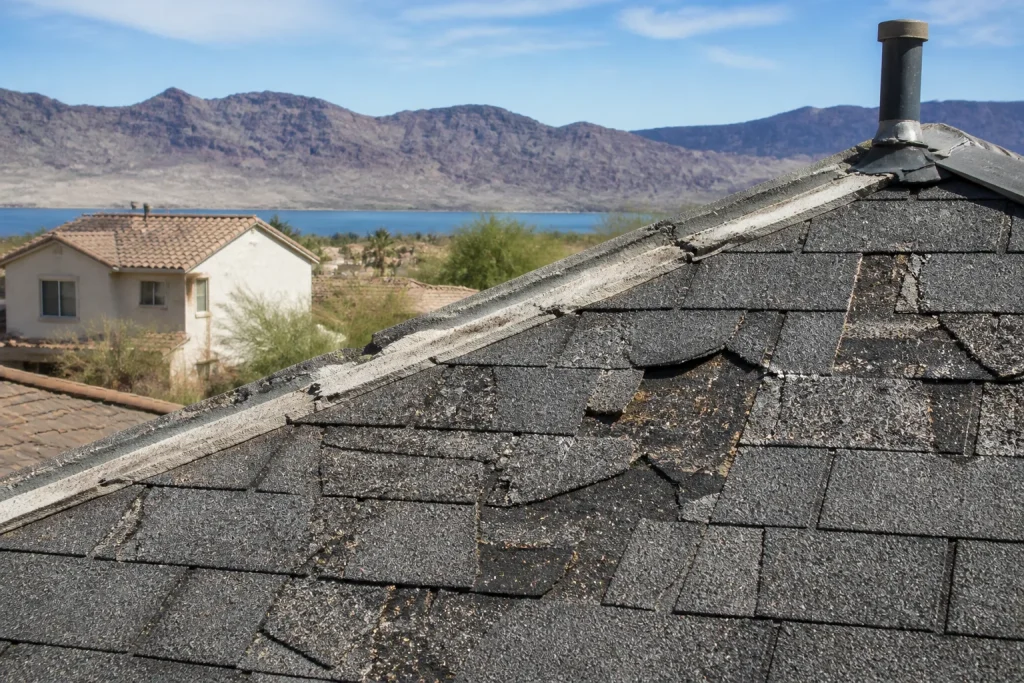
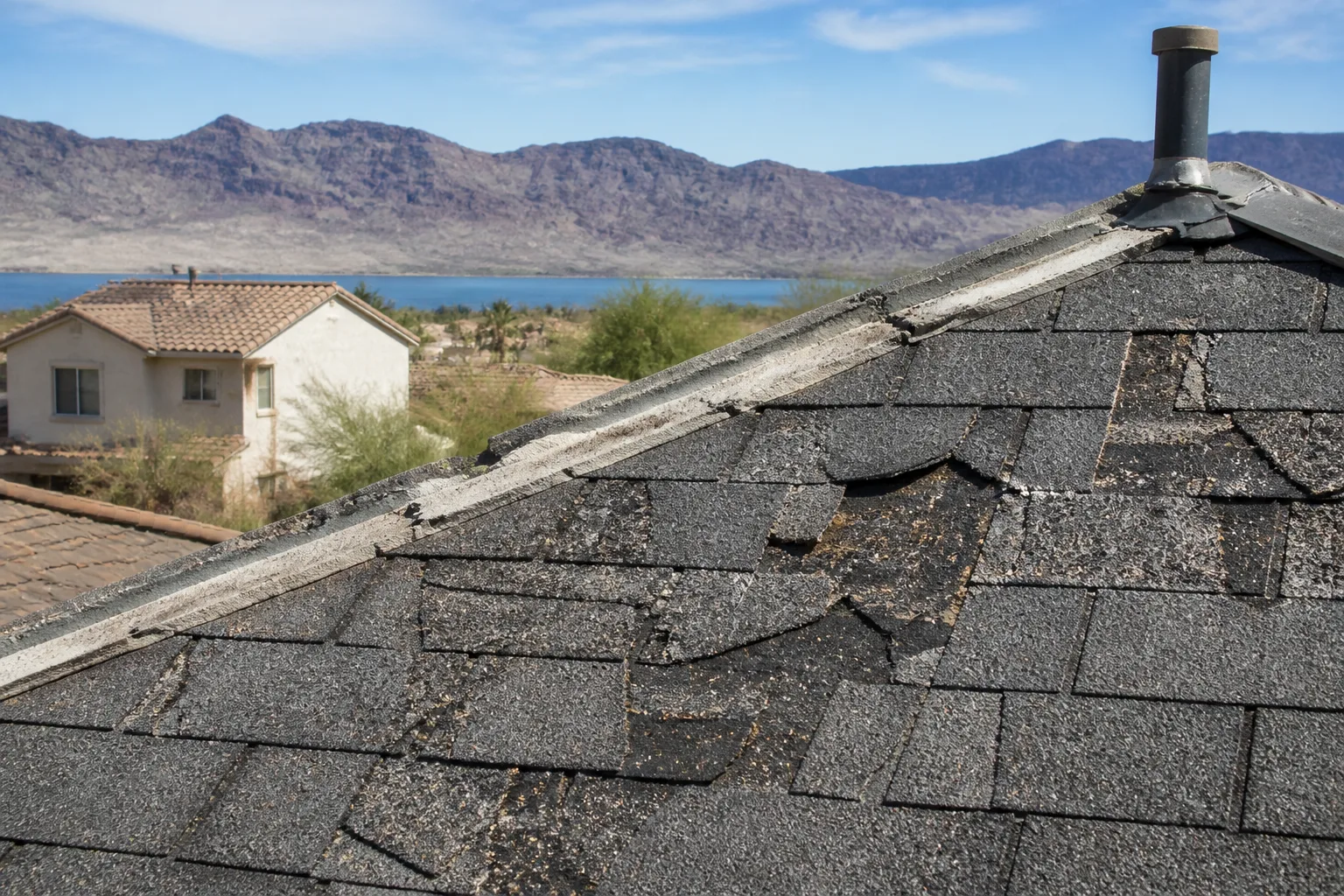
Top Signs You Need Roofing Service – Don’t Ignore These
Most roofing warning signs homeowners watch for are the last ones to show up. Water stains on the ceiling and shingles scattered across the yard mean the problem has been building for months. In Boulder City, the earliest signals are quieter, sun-baked, and easy to miss if you don’t know what you’re looking at. The good news: catching them early is often the difference between a $400 repair and a $6,000 replacement. This guide walks you through what to actually look for, from the ground, before the damage gets expensive.
Why the Usual Warning Signs Show Up Too Late
The signs every roofing article lists are real, but they’re late warnings. Missing shingles, water stains, a sagging roofline: those are symptoms of a problem that’s already done its work. By the time water reaches your ceiling in Boulder City, it has usually traveled through the deck, insulation, and drywall first. The stain you see is the last stop on a long trip.
What we’ve learned after years on roofs here is that Boulder City’s desert climate creates its own early warning system. Intense UV, wide day-to-night temperature swings, and the occasional hard monsoon all stress a roof in specific ways. Those stresses leave clues. Some are in your gutters. Some are around your HVAC and swamp cooler penetrations. Some are in the wood at your eaves.
These early clues share a common trait: they’re visible from the ground if you know what to look for, and they show up long before anything leaks inside. That’s the golden window. Fix the flashing while it’s a flashing job. Ignore it, and it becomes a deck replacement.
Key Takeaways
- The warning signs that matter most in Boulder City show up outside, not inside.
- Excessive gutter granules, cracked sealant, and soft fascia wood are early signals.
- Flat and low-slope sections fail differently from pitched ones and need their own check.
- Most early-stage repairs cost hundreds; most late-stage ones cost thousands.
- If you’d rather not climb up there yourself, just call. We’ll take a look and tell you the truth.
What Your Gutters Are Telling You (And You’re Walking Right Past)
We can read a roof’s condition from the gutters more reliably than from the shingles. Granules collecting in the gutter channel are normal in small amounts. Every asphalt shingle, whether it’s a GAF, CertainTeed, or Tamko product, sheds granules as it ages. A little seasonal shed is expected.
Here’s the benchmark that actually matters. After a light rain, run your hand along the bottom of the gutter. If you’re finding a thin, scattered grit, that’s ordinary. If you’re scraping up a thick, sand-like layer that fills the channel, or shoveling out cups of loose granules after a dry week, that’s a signal the shingle’s protective coating is breaking down faster than it should. UV exposure in Boulder City accelerates this.
We pulled a set of gutters apart on a home near the Boulder City Golf Course last spring where the granules were nearly an inch deep. The homeowner hadn’t been on the roof in years and had no idea. The shingles looked fine from the driveway. Up close, they were starting to fail. A repair at that stage ran a few hundred dollars instead of the replacement it might have become.
Also check the gutter itself. Sagging sections, rust streaks, or water spilling over the front edge (not the back) all tell you the gutter and the roof edge aren’t working together anymore. When gutter problems show up, they almost always point to something underneath.
Flat and Low-Slope Sections Fail Differently Than Pitched Roofs
Boulder City homes often have flat or low-slope sections, especially over additions, patios, and garages. Those sections don’t fail the way pitched shingled areas do. They don’t lose granules or crack the same way. They pond water, blister, and pull at the seams.
What to look for on a flat or low-slope section:
- Ponding water that stays hours after rain. A flat roof should drain within a few hours. Standing water stretches the membrane and finds seams.
- Bubbles or blisters. These look like raised, soft spots and mean trapped moisture under the membrane.
- Open seams or lifted edges. The most common failure. The sun shrinks and pulls the membrane back from the edge and the seams open up.
- Patching that’s patching the patching. If a low-slope section has been patched three times, it’s telling you the current system is at the end of its life.
These early failures don’t always leak right away. They hold water under the surface and rot the deck from underneath until the problem shows up as a soft spot or a ceiling stain somewhere completely unexpected. Check low-slope sections more often than pitched ones, especially after a monsoon. Boral low-slope systems and proper membrane products handle the desert heat better than old, patched-up assemblies, which is why repairs or upgrades usually pay for themselves.
Flashing Around HVAC and Swamp Cooler Penetrations
This is the number-one source of early roof leaks in Boulder City. Every HVAC unit, swamp cooler, and vent pipe cuts through the roof, and each penetration needs flashing and sealant. Here, the wide day-to-night temperature swing works that sealant like a stress test, expanding and contracting it every single day. The sealant cracks first, and the water follows.
What to look for around a penetration:
- Separation between the flashing collar and the roof surface. Any visible gap, even a hairline, is where water gets in.
- Cracked or peeling sealant. It should be continuous and flexible, not cracked, dry, or missing in patches.
- Rust streaks trailing from the penetration. Water is moving where it shouldn’t.
- Ponding or dark staining around the base. Especially near swamp cooler platforms, where moisture is often constant during the cooling season.
The tricky part: this looks cosmetic. A cracked sealant bead on a sunny day doesn’t scream “leak.” But it’s the most common early-stage repair we get called for in Boulder City, and it’s a cheap fix if you catch it and a deck repair if you don’t. Have a roofer check the flashing around every rooftop unit at least once a year. It’s a small visit that prevents a big bill.
Cracking Fascia and Soft Soffit Wood
Look at the fascia boards (the wood the gutter is nailed to) and the soffit (the underside of the eaves). If the wood is cracking, peeling, or feels soft to the touch, that’s a sign of moisture reaching the roof deck even if you haven’t seen a single stain inside. Wood doesn’t soften for no reason.
Boulder City’s UV can make paint and sealant fail on fascia too, exposing the wood and letting water in at the edge of the roof. Once the edge of the deck starts to take on water, things get serious. That’s the moment to call a pro before the moisture spreads inward. This is exactly the point where an early call to a good roof repair in Boulder City saves you thousands. Small repairs now beat the kind of repair that means tearing into the deck.
Run your thumb along the bottom edge of the fascia. If it gives, or if the wood feels crumbly, have it looked at. And if your gutters are pulling away from the fascia, that’s the same story: water at the edge, wood at the end of its life, roof that needs help.
The UV-Degraded Sealant Pattern Around Vents
Here’s a sign that looks purely cosmetic but isn’t. Look at the sealant rings around the small bath, plumbing, and attic vents on the roof. Boulder City’s sun bakes the sealant and degrades it from the top down. You’ll see a ring of cracked, dry, separated sealant that’s no longer sealing anything.
This is the pattern every homeowner walks past. It’s not a missing shingle. It’s not a stain. It’s a dried-out ring of caulk that’s given up. But it’s exactly where water gets in during the first hard rain after the dry season. The sealant does its job when it’s flexible. Once it’s brittle, it’s done. Standard shingles from GAF and CertainTeed are built to handle desert conditions, but the sealant around the vents is only as good as it is today.
The fix is small: re-seal or replace the vent collar. The cost of ignoring it is anything but small. That dried bead of sealant is the entry point for water that ends up in the insulation and ceiling below. If you see a ring of cracked sealant around any vent on your roof, that’s the cue to call and have it checked and corrected before the rainy season.
When to Call a Pro
Some roof checks are safe from the ground. Looking at gutters, fascia, and soffit is fine. Climbing up and walking a roof is a different story: it’s dangerous, and one misstep causes a whole new problem. If you see granules in the gutters, cracked sealant, soft fascia, or ponding on a flat section, that’s the point to call a pro rather than go up yourself.
Our technicians have up to 30 years of experience with every roof system that goes here, and we’ll show you the deck photos before we talk money. You don’t have to take a guess about what’s happening up there. For more on roof repair or a bigger project, we can walk you through roof replacement and installation in Boulder City and the different systems that hold up here. If a metal system is on your mind, we also handle metal roofing in Boulder City.
The Bottom Line
The signs that matter most in Boulder City show up early and outside: granules in the gutters, cracked sealant around vents, separated flashing at your swamp cooler, soft fascia wood, and ponding on the flat sections. Catch them at the repair stage and you’re usually in the hundreds. Wait for the interior stain and you’re often in the thousands. That’s the whole reason to learn what you’re looking at from the ground.
We’ve seen it go both ways, and the early catch is always the cheaper one. If you’re in Boulder City and need help, we offer free estimates, a free second opinion on any written estimate, and no trip charge inside our own county. Call (844) 761-8186 and we’ll take a look. And when you’re ready for the full picture of what we do, start with the Shepherd & Sons Roofing Boulder City home page.
Frequently Asked Questions
Thin, scattered grit is normal seasonal shed. A thick, sand-like layer filling the channel, or cups of loose granules after a dry week, means the shingle coating is breaking down. If you’re finding that much, have a roofer check the roof. Call (844) 761-8186 for a free estimate.
Yes, and that’s the safest way. Look at gutters, fascia, soffit, and the flashing around HVAC and swamp cooler penetrations from the ground. Don’t walk the roof yourself; height work is dangerous. Call the pros for anything on the roof surface. (844) 761-8186 gets a real person on the phone.
Boulder City’s daily temperature swing expands and contracts the sealant until it cracks. That’s why vent sealant needs to be checked and re-sealed regularly. It looks cosmetic but it’s a leak waiting to happen. Call (844) 761-8186 and we’ll tell you what’s worth fixing.
Almost always. A flashing or sealant repair runs in the hundreds. Once water soaks the deck and insulation, you’re usually in the thousands. Catching it early is the single biggest cost saver. Call (844) 761-8186 for a free estimate and we’ll give you the honest number.
Written by the team at Shepherd & Sons Roofing Boulder City.
Need Roofing Help?
Call Shepherd & Sons Roofing Boulder City - licensed & insured, here with fast after-hours help in Boulder City.
(844) 761-8186