
5 Mistakes to Avoid With Tile Roofing
Concrete tile weighs 9 to 12 pounds per square foot. That’s roughly three to four times what an asphalt shingle roof puts on your framing, and it’s the number behind almost every tile roofing mistake we get called out to fix in Boulder City. Most of those mistakes trace back to one thing: a roofer who treated tile like a heavier version of shingles. Tile load, tile ventilation, and tile repair all follow their own rules. Get them wrong and the problems surface years later, usually after the first hard monsoon season.
Below are the five we see most, what each one costs you, and how to spot it before you sign. If you’d rather have a trained eye look at your roof than climb up there yourself, call (844) 761-8186 and we’ll come take a look.
Key Takeaways
- Never let anyone install tile without first verifying your roof structure can carry the load.
- Standard #30 felt under tile doesn’t survive a desert summer the way a proper underlayment does.
- Walking on tile cracks it in ways you can’t see from the ground.
- Re-mortaring a ridge without new underlayment underneath is a patch, not a repair.
- Tile should be fastened with copper or stainless screws, not roofing nails.
Mistake 1: Installing Tile Without a Structural Load Assessment
This is the big one, and it’s the one that can turn a roofing job into a framing job. Before a single tile goes down, someone needs to confirm your roof structure can carry the added weight. The number of roofers who skip that check before a tile installation would genuinely surprise you. We’ve walked onto Boulder City roofs where the previous crew went straight to work and never looked at the framing at all.
Nevada’s building code treats roof covering as a structural consideration, not a cosmetic one. The adopted code requires that the roof structure be designed for the dead load of the covering, and a tile roof’s dead load is a different figure than shingles. In practical terms that means:
- Dead load of the covering has to be compared against what the framing and sheathing were designed for.
- Older homes, and homes where a previous owner swapped roofing materials, are the ones most likely to fall short.
- If the structure can’t carry it, the fix is reinforcement or a different roofing material entirely, and both need to be decided before work starts, not after.
When we quote tile in Boulder City, the load question gets answered first. It’s not a scare tactic. It’s the difference between a roof that lasts thirty years and one that sags at the ridge in eight. The technician you want on a tile job is one with real experience reading framing, not one who’s only ever set asphalt. Our own people carry up to 30 years of that kind of experience, and it matters on exactly this step.
Mistake 2: Using the Wrong Underlayment Under Tile in a Desert Climate
Tile is a rain screen, not a waterproof layer. The underlayment beneath it does the actual waterproofing, and in a desert climate it takes a beating no shingle roof ever sees. Standard #30 felt is the underlayment a lot of crews reach for out of habit. Under tile in Boulder City, it’s the wrong specification. Between the summer heat cycling and the UV that sneaks past cracked or slipped tiles, felt dries out, becomes brittle, and starts to tear.
The right specification looks different. What we look for:
- A high-temperature synthetic underlayment rated for the heat a tile roof traps underneath it, or a proper self-adhered membrane in the valleys and at penetrations.
- Correct laps and fastening so the underlayment actually sheds water instead of holding it against the deck.
- Batten or counter-batten detailing done to the manufacturer’s spec, so air can move and the tile isn’t sitting directly on the membrane.
Here’s what makes this mistake so expensive. The underlayment is the part you can’t see. By the time a homeowner notices a stain on the ceiling, the underlayment has usually been failing quietly for years. When we quote a tile roof in Boulder City, we name the underlayment product in the written estimate, the same way we name the shingle brand on an asphalt job. If a bidder won’t tell you what’s going under the tile, that’s your answer.
Mistake 3: Walking Tile Without Proper Technique
Tile cracks. Not always dramatically, and not always where you can see it. A roofer who walks across a tile field in work boots, stepping wherever feels natural, breaks tiles that pass the eye test from the ground. Hairline cracks open up. Broken corners let water past. A year later the leak shows up over the living room and nobody connects it to the day someone walked the roof.
Good tile work treats foot traffic as a skill. In our experience, the crews who do it right follow a few rules:
- Step on the overlap where one tile laps the next, where the tile is strongest, never in the middle of a field tile.
- Keep weight on the battens and the structural lines, not on unsupported spans.
- Use soft-soled shoes, and on steeper pitches, roof jacks and boards rather than free walking.
- Carry a small stack of matching replacement tiles so any cracked piece gets swapped during the job, not left for later.
This is also why we photograph the deck and the tile field before and after, and show you those photos before we talk money. Tile roofing in Boulder City means harsh sun and freeze-thaw at the edges of the high desert, and tile that’s been walked carelessly fails faster under both. On a repair, ask the roofer how they’ll get across your roof without breaking tile. The answer tells you a lot.
Mistake 4: Repointing Mortar at the Ridge and Hip Without New Underlayment
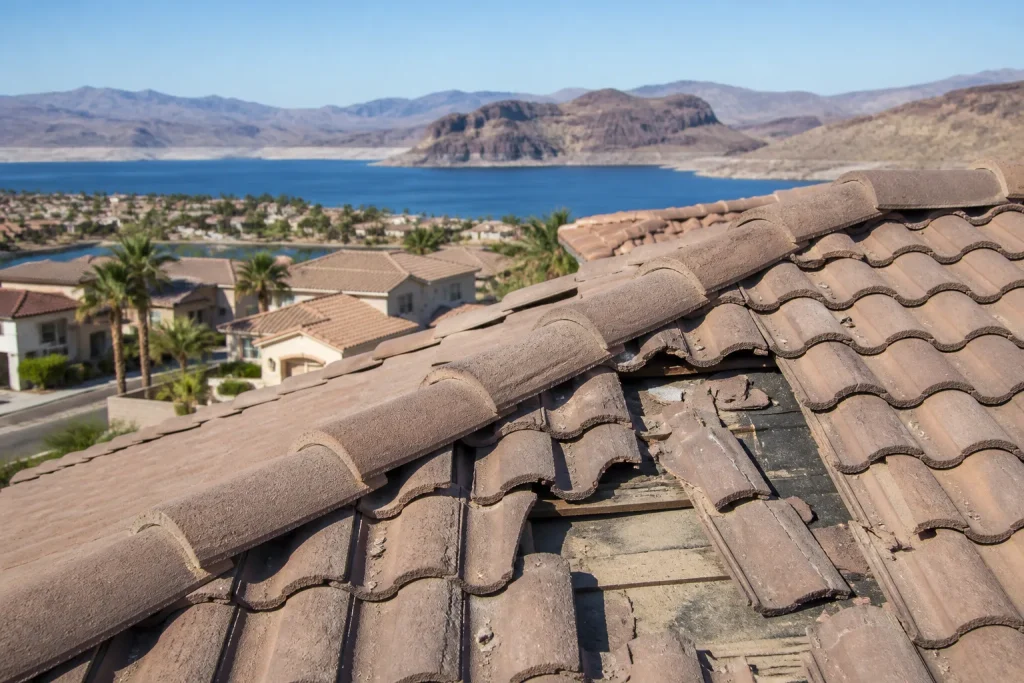
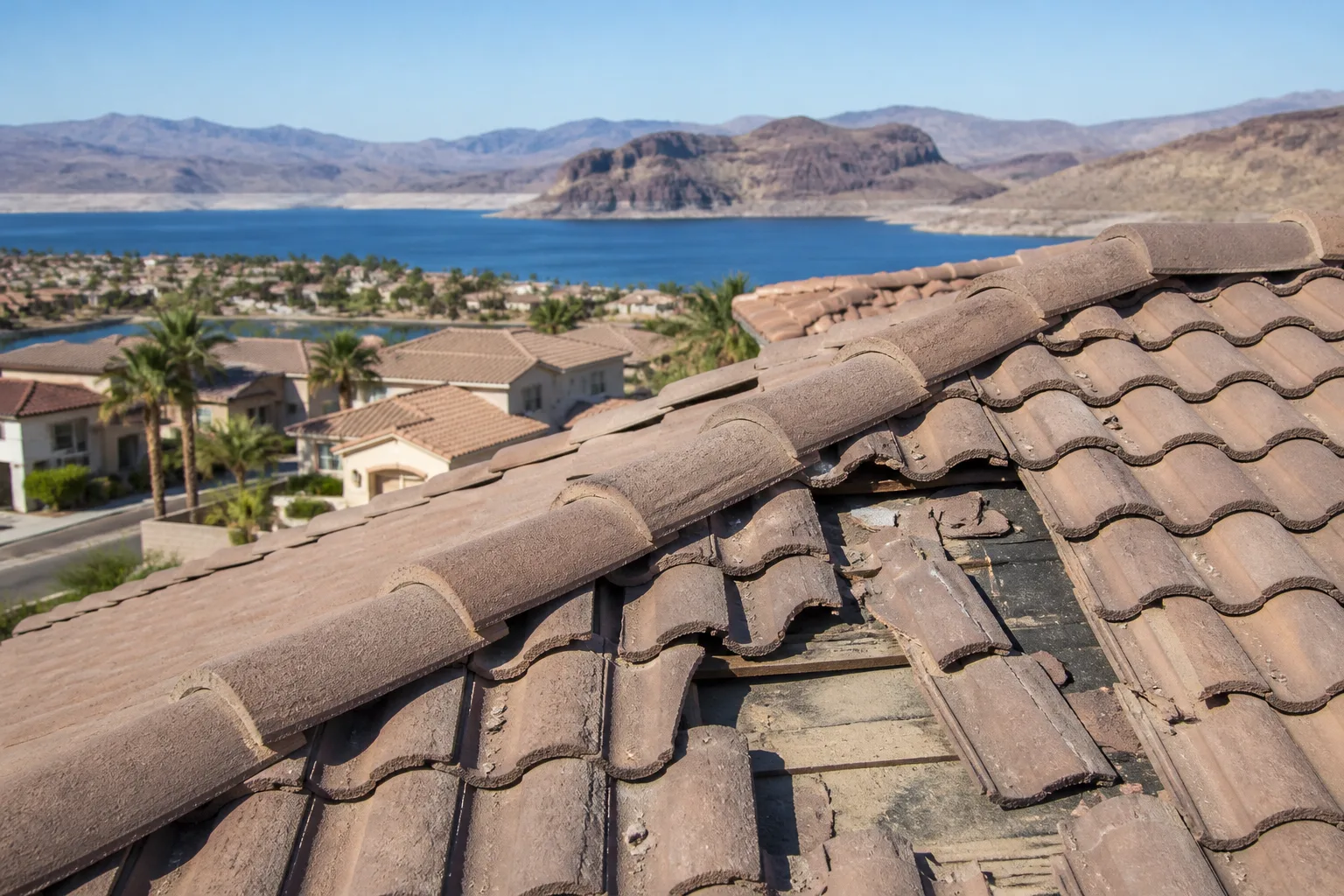
This is the most common tile repair we get called to, and it creates the most false confidence. The mortar at a ridge or hip cracks, a homeowner or a quick-fix roofer scrapes it out and packs in new mortar, and the roof looks solid again. What didn’t get fixed is the reason the mortar cracked in the first place, and the underlayment beneath it that’s been taking water the whole time.
Mortar fails from movement and from water getting behind it. If the underlayment under the ridge is worn through, repointing the mortar just seals the water in. The leak keeps working its way into the deck. Months later, a ridge repair turns into a deck repair.
A real ridge or hip repair in Boulder City means:
- Lifting the affected ridge or hip tiles and inspecting the underlayment underneath.
- Replacing any failed underlayment before the tile goes back on.
- Re-setting the tile with proper fasteners and, where the manufacturer specifies it, flexible mortar or a ridge vent system.
If a roofer quotes you a ridge repoint without lifting a tile, ask what’s under it. If they can’t tell you, that’s not a repair. It’s a coat of paint over a problem. Our 90-Day Done Right Promise exists for exactly this reason: if a repair isn’t done right, we come back and make it right, in writing, on every job.
When to Call a Pro
Tile repair is one of those jobs where the injury risk and the damage risk both run high. Tiles are heavy, slippery when dusty, and the pitches on tile roofs are often steeper than they look from the ground. Add in the fall risk and the ease of cracking good tile while you’re up there, and this is not a weekend project. If you’ve got a cracked ridge, a stain on a ceiling, or tile that’s slipped out of line, that’s a call-a-pro moment. And you can read more about what we handle under Roof Repair in Boulder City.
Mistake 5: Hiring a Roofer Who Fastens Tile With Roofing Nails
Tile should be fastened with copper or stainless screws, not standard roofing nails. This one shows up five years later, and by then it’s expensive. A steel roofing nail in a tile roof in Boulder City’s climate will corrode, and when it does, the tile loosens, slips, and lets water behind the field. The nail head rusts and stains the tile face. The tile above it starts to chatter in wind.
Why does it happen? Because nails are faster and cheaper, and a roofer who doesn’t do much tile work reaches for what he knows. The fastener is where a shingle-minded crew and a tile-experienced crew part ways. On the tile we install, we specify the fastener in the written estimate and use the manufacturer’s recommended corrosion-resistant screws, which is the same standard we hold to on the Roof Replacement & Installation in Boulder City work and the tile details on our Metal Roofing in Boulder City projects.
The fix when you catch it early is a re-fastening and inspection. Caught late, it means lifting field tile, replacing fasteners, and sometimes the underlayment that’s been getting wet. Ask any tile bidder what they fasten with. If the answer is “roofing nails,” keep calling.
Want the honest version of where your roof stands? Start with our Shepherd & Sons Roofing Boulder City home page or just pick up the phone.
How Do You Choose a Tile Roofer You Can Trust?
Ask three questions before you hire anyone for tile work. One, can they verify your roof structure can carry the tile load, and will they put the load discussion in writing? Two, what underlayment product goes under the tile, named specifically? Three, what fasteners do they use? A roofer with real tile experience answers all three without hesitation. A roofer who’s mostly done shingles usually stalls on the underlayment and the fasteners.
Then check what’s on paper. A published address. A license number you can look up. A written, itemized estimate that names materials. And a workmanship promise in writing, not on a business card. Same address on the estimate as the one on the truck. In Boulder City, we’ve kept the same address since 1996, and Bill’s name goes on every job.
The Bottom Line
Tile roofing fails for predictable reasons, and all five of these mistakes come down to one root cause: a crew treating tile like a heavier shingle. Verify the load before anyone installs. Name the underlayment in the estimate. Don’t walk the tile carelessly. Replace the underlayment when you repoint a ridge. Fasten with screws, not nails. Get those five right and a tile roof in Boulder City will outlast most of the other roofs on your street.
If you’re in Boulder City and need a straight answer on your tile roof, Shepherd & Sons Roofing offers free estimates, a Free Second Opinion on any written estimate you’ve already got, and no trip charge inside our own county. Call (844) 761-8186 to schedule your free estimate. A live person with real tile experience picks up the phone, day or night. Our technicians carry up to 30 years of tile experience, and every job is backed by our written 90-Day Done Right Promise.
Frequently Asked Questions
Most tile repairs in Boulder City run somewhere in the range of a few hundred dollars for a small repoint or tile replacement to well over a thousand for a ridge or hip rebuild that includes new underlayment. The estimate should itemize labor, materials, underlayment, and fasteners, and it should be free. Call (844) 761-8186 for an exact quote. Estimates are free, and we offer $40 Off Any Repair Over $200.
Ridge mortar cracks because it dries out, moves with temperature swings, and takes on water once the underlayment beneath it wears through. Repointing the mortar without replacing that underlayment just hides the leak. The fix is to lift the tile, replace the underlayment, and reset the tile properly. Call (844) 761-8186 and we’ll take a look and tell you what’s actually happening.
Yes, but only with technique that avoids cracking tile. It means stepping on the overlap where tile is strong, keeping weight on the battens, using soft-soled shoes, and carrying replacement tile for any piece that breaks. Careless walking is one of the most common causes of new leaks in Boulder City. If you want a proper inspection without risking your own tile, call (844) 761-8186.
Yes. Tile roofing involves structural load verification and underlayment requirements that fall under the building code, so a permit is the right path on a full tile install or a significant repair. We handle the permit and the inspection as part of the job so you’re not stuck chasing it, and we don’t start work until it’s clear. Call (844) 761-8186 to schedule your free estimate.
Tile isn’t the only roof we work on. If you’re comparing materials, our Metal Roofing in Boulder City page walks through how metal handles the desert heat, and our Roof Repair in Boulder City page covers the repairs we do most often. On a full replacement, see Roof Replacement & Installation in Boulder City.
Written by the team at Shepherd & Sons Roofing Boulder City.
Need Roofing Help?
Call Shepherd & Sons Roofing Boulder City - licensed & insured, here with fast after-hours help in Boulder City.
(844) 761-8186