
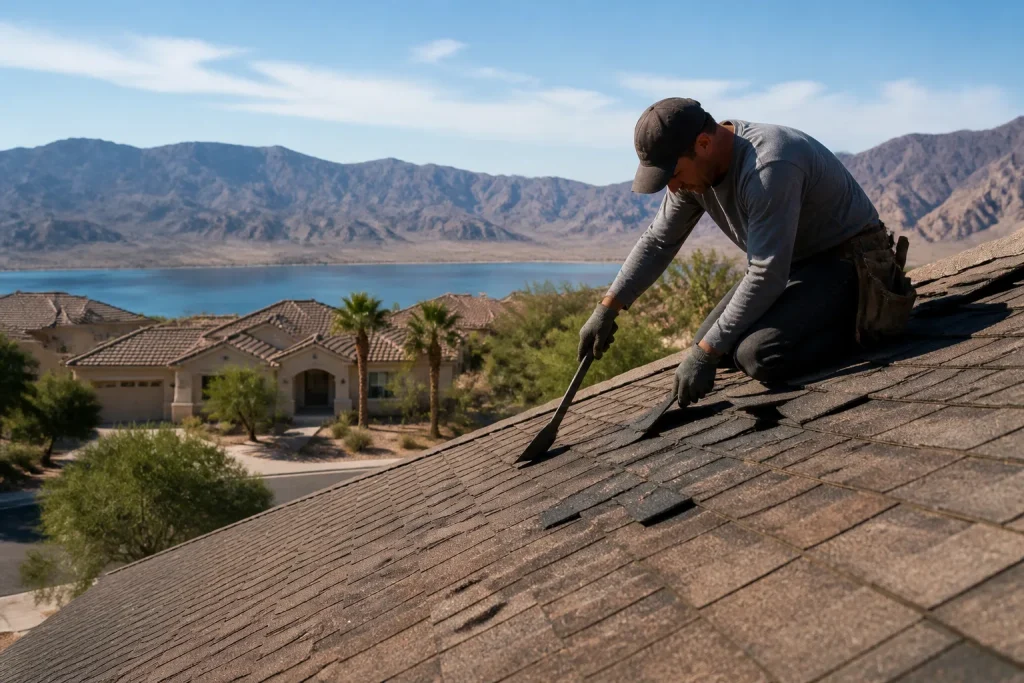
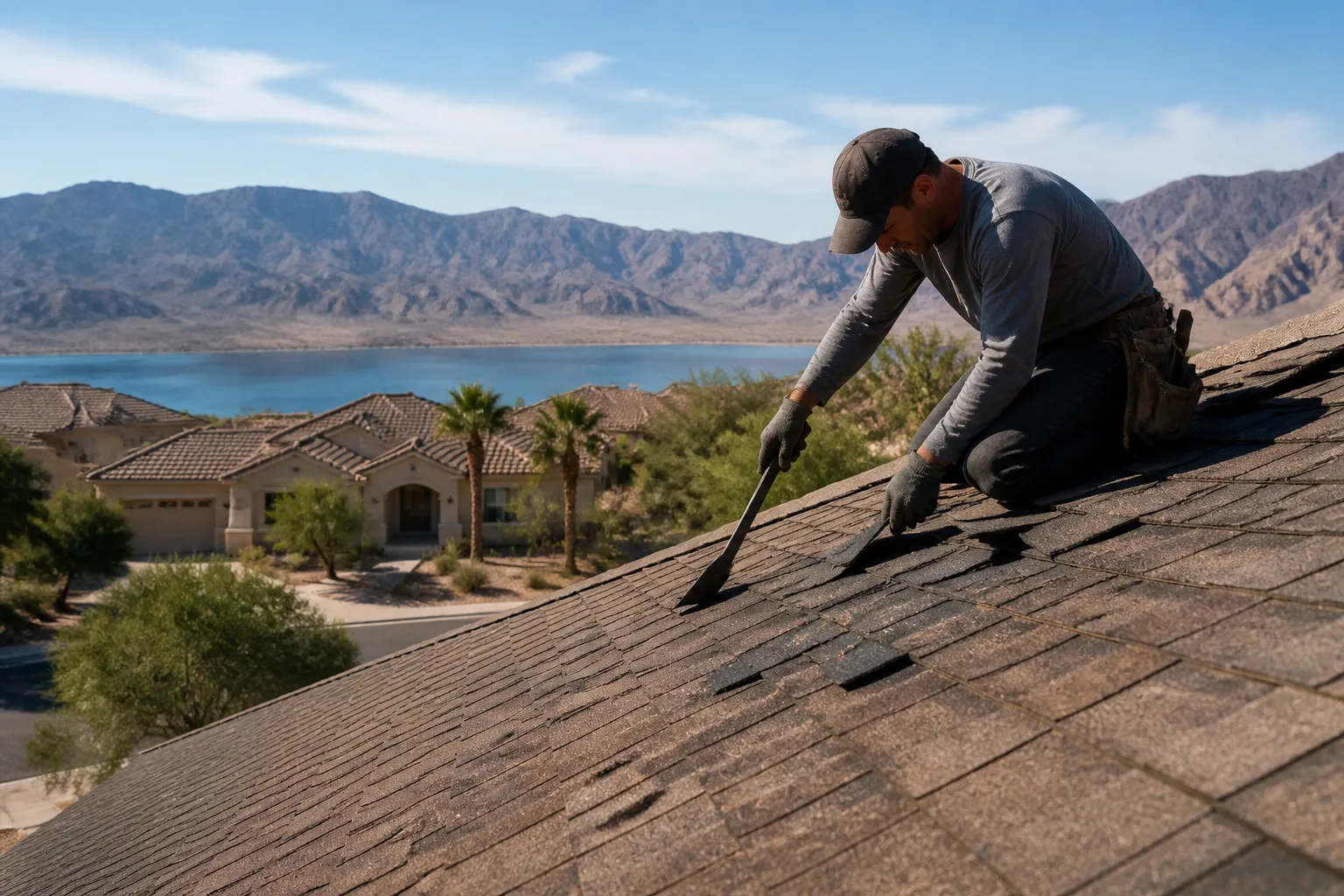
Atlas Roof Repair in Boulder City: A Homeowner’s Guide
Atlas shingles carry one of the better lifetime warranties in the industry, but that warranty has a contractor certification requirement buried in the fine print. If the wrong roofer does your repair, even a skilled one with good intentions, the coverage on that slope can be voided. We’ve seen it happen in Boulder City more than once: a homeowner hires a handy generalist, the repair looks fine for two summers, then a leak shows up and the claim gets denied. Here’s how to avoid that.
If you’d rather hand the whole thing to someone who knows how to keep your Atlas coverage intact, call us at (844) 761-8186 for a free estimate.
What most Boulder City homeowners don’t know about Atlas warranties
When a builder put Atlas Signature Select shingles on your roof, the paperwork you got at closing probably said “lifetime limited warranty.” What it doesn’t say in bold is that certain coverage tiers – especially the longer labor-and-material portions – require work to be performed by an Atlas-certified contractor. Do the repair with a roofer outside that program and you don’t lose the whole warranty, but you can lose the enhanced portion, and Atlas can argue the repair itself caused the later damage. That’s the part that bites.
Boulder City has a lot of homes built between roughly 2000 and 2020 where the original builder used Atlas shingles, so this isn’t a rare situation here. It’s the norm in a lot of the newer pockets off Nevada Way and the neighborhoods that grew up around the Boulder Creek Golf Club. If your roof is original from that era, you’re probably sitting on Atlas shingles right now.
The warranty system itself is legitimately strong – it’s one of the reasons builders like Atlas in the first place. It just doesn’t pay out the way most people assume. Coverage on paper and coverage in practice are two different things when the repair crew doesn’t meet Atlas’s requirements.
How the Atlas Signature Select contractor certification works
Atlas runs a tiered contractor program. Signature Select is the top tier, and to hold it a roofer has to be vetted by Atlas, carry the right insurance and licensing, commit to using genuine Atlas materials on qualifying projects, and follow Atlas installation specs. Not every roofer who installs Atlas shingles is certified. Plenty of roofers buy Atlas product when the price is right and never join the program, which is fine for a straight install but a problem when warranty work is on the line.
Here’s how to check before you let anyone touch your roof:
- Ask the roofer directly: “Are you an Atlas Signature Select contractor?” Get a yes or no, not a story about how they’ve “installed plenty of Atlas.”
- Ask them to show the certification or point you to their listing in Atlas’s contractor locator. A real certified roofer won’t blink at this.
- Ask what Atlas materials they’ll use on your specific repair – shingle, underlayment, starter, whatever’s called for. A certified roofer will know; a generalist will guess.
- Get it in writing on the estimate that the repair will be performed to Atlas specification. That clause is your protection if a dispute ever comes up.
If a roofer dodges question one, that’s your answer. In our experience the roofers who are certified lead with it, because it takes work to earn and it’s worth bragging about.
Which Atlas products are on Boulder City roofs, and what repairs fit them
Boulder City’s 2000s-through-2020s housing stock mostly carries a few Atlas lines. Matching repair materials to the actual shingle matters, because a mismatched repair can look fine from the street and fail at the edges within a couple of seasons:
- Atlas StormMaster Shake and StormMaster Slate – common on the higher-end builds from the 2010s. These are thicker, heavier profiles. Repairs need matching hip-and-ridge and the same profile so the patch doesn’t read as foreign.
- Atlas Pinnacle Pristine – a very popular architectural shingle in this era. Repair-friendly, but you have to match the color and the exposure so the seam doesn’t telegraph.
- Atlas Legend – the older heavyweight architectural line, seen on early-2000s builds. Matching color is trickier now because some of those dye lots are gone, so partial-slope replacement is often cleaner than a small patch.
- Atlas Pro-Cut and companion underlayments – what’s underneath matters as much as what’s on top, especially in Boulder City’s summer heat.
Because we install Atlas alongside CertainTeed, Owens Corning, and IKO, we can tell you honestly whether the repair should use Atlas material or whether it’s a slope that doesn’t need to match – a rear shed roof, say, or a detached garage. Sometimes the right answer is a quality non-Atlas match if it’s going to save you money without threatening coverage. That call belongs in the estimate, not the sales pitch.
How Atlas shingles hold up in Boulder City’s desert heat and UV
Boulder City is hard on shingles. Summer surface temperatures on an asphalt roof regularly climb into the 160s, the UV load is relentless, and there’s very little of the tree shade that shingles in wetter climates get to hide under. Atlas architectural shingles handle that heat reasonably well – they’re rated for it and the granular surface resists UV degradation about as well as anything on the market. But “holds up well” isn’t the same as “holds up forever,” and the wear shows up in predictable places.
What we see first in Boulder City:
- South and west-facing slopes lose granules and dry out faster than the rest of the roof. That’s the first place a repair becomes necessary.
- Hip and ridge caps crack and curl after 12 to 15 years of sun exposure, even when the field shingles are still solid.
- Flashing at penetrations – vents, pipe boots, chimney – dries out and pulls loose. That’s a flashing repair, not a shingle repair, and it matters who does it.
- Valleys collect heat and debris, so ice-dam protection isn’t a Boulder City concern but UV degradation in the valley is.
Where Atlas holds up: the field shingles on the cooler north and east slopes tend to last well past their nominal lifespan out here. Where it shows wear first: exposure, edges, and any slope with a lot of western sun. If your repair is on a west-facing slope, the materials chosen matter more than they would on the back of the house.
Cosmetic repair vs. a patch that voids your warranty
The difference between a repair that preserves your Atlas warranty and one that quietly destroys it isn’t obvious. Both can look fine from the driveway.
Here’s what a warranty-preserving repair looks like in our experience:
- Matched Atlas material on the slope being repaired, or an approved equivalent documented in writing.
- Correct nailing pattern – six nails vs. four, four inches above the exposure line, set by Atlas spec. Nail it wrong and the wind rating evaporates, and the warranty claim along with it.
- Proper underlayment replacement, not a shingle laid over a torn underlayment because it was faster.
- Flashing replaced or reworked at penetrations, not loaded with caulk and called done.
- Documentation – photos of the repair, materials used, and who did the work. That paperwork is what you hand Atlas if a claim ever comes up.
A shoddy repair is one of three things: wrong material, wrong nailing, or skipped underlayment. We’ve pulled Atlas repairs off slopes on homes here where the previous roofer had stapled shingles back on and loaded the seams with sealant. That’s not a repair, it’s a delaying tactic, and when it fails Atlas can point right at it and deny the claim. If you’re not sure what you’re looking at, our Roof Repair in Boulder City page walks through how we assess a repair before quoting it.
What to bring to your repair appointment to protect the warranty
The repair conversation goes a lot smoother, and your warranty becomes a lot easier to defend, if you bring a few documents. We ask for these up front because in a dispute Atlas will ask for them, and it’s better to know what you have than to find out after the fact.
- Your original builder documents – the closing packet, the builder’s warranty paperwork, any shingle manufacturer literature that came with the house. This is the single most important thing. If you can find the shingle name and lot number, save it.
- Any prior repair invoices – even from a previous owner. If a slope has already been repaired, we need to know what was done and by whom, because that repair affects what Atlas will cover going forward.
- Photos of the leak or damage – from the attic if you can get up there safely, and from the ground. Photographs make the initial inspection faster and document the problem.
- Your insurance paperwork if a claim is involved – not every repair should involve insurance, but if a storm damaged the roof, this is where a claim and warranty claims interact and it helps to see both.
If you can’t find the builder packet – and honestly, most homeowners can’t – don’t worry about it. Atlas can often trace the shingle from the address and build year. What matters is being honest about what you have and letting the roofer tell you what he needs.
When to call a pro (and when to leave it alone)
A few things on this roof are safe to check yourself. A lot aren’t. If you can see a missing shingle, a lifted edge, or a ceiling stain, you’re already in “call someone” territory – the question is who, not whether. Atlas repairs are one of the cases where the certification question genuinely decides whether the call was the right one.
What not to do: get up on the roof in August in Boulder City to “look at it yourself.” The heat, the pitch, and the height are a bad combination, and a pulled muscle or a fall costs more than any repair. We’ve made plenty of house calls where the homeowner was about to climb a ladder and we were glad they didn’t. The inspection is free.
What to do instead: call, describe what you’re seeing, and let a roofer who knows Atlas tell you whether it needs repair, replacement, or nothing at all. Sometimes the honest answer is “that’s cosmetic, leave it.” You’d rather hear that than a sales pitch.
Related services in Boulder City
If the inspection turns up more than a repair – a slope that’s aged out, or a roofing decision you’ll be making once and living with for 30 years – we cover Roof Replacement & Installation in Boulder City and Metal Roofing in Boulder City. You can also see the full range of work we do on our Shepherd & Sons Roofing Boulder City home page.
Key takeaways
- Atlas Signature Select certification matters for warranty repairs. Ask the roofer before work starts.
- Match repair materials to the actual Atlas product on your roof. StormMaster, Pinnacle Pristine, and Legend all want different companions.
- Boulder City’s UV and heat wear the south and west slopes first. That’s the repair you’ll make.
- Cosmetic repair and warranty-voiding repair look similar from the street. Documentation is what tells the difference.
- Bring builder paperwork, prior invoices, and photos to your estimate if you have them.
The Bottom Line
An Atlas roof in Boulder City is a good roof, and the warranty behind it is worth protecting. That protection comes down to two questions: is your roofer certified, and was the repair done to Atlas specification with matching Atlas material? Get both answered in writing before anyone climbs the ladder, and the warranty system does what it’s supposed to do – cover you when something goes wrong. Skip either question and you may be paying for the same repair twice.
If you’re in Boulder City and need a second set of eyes on an Atlas roof, or want to know whether the repair you’re looking at is going to keep your coverage intact, we offer free estimates and free second opinions on any written estimate you’ve already got. Call (844) 761-8186.
Frequently Asked Questions
For most minor repairs you can legally hire anyone, but you can lose the enhanced portions of an Atlas warranty if the repair isn’t done by a certified contractor using Atlas materials. On a roof that still has years of coverage left, the safer call is a certified roofer. Call (844) 761-8186 and we’ll tell you what your specific roof needs.
Check the original builder packet or closing documents from when the house was built; builders in this area commonly used Atlas in the 2000s and 2010s. If the paperwork is gone, a roofer can usually identify the shingle by sight or by the profile. We can tell you at the estimate. Call (844) 761-8186 to set one up.
A voided repair typically affects the slope that was repaired, not the entire roof, but the exact scope depends on the warranty terms and how the repair was done. That’s why the paperwork matters. A free second opinion can tell you whether the repair you’re considering puts the rest of the roof at risk. Call (844) 761-8186.
Small repairs commonly run a few hundred dollars, while a partial-slope repair with matched Atlas material and updated flashing runs higher – the number depends on how much slope is affected and what materials your shingle line requires. We give free estimates in writing so you see the line items before anyone touches the roof. Call (844) 761-8186 for yours.
Written by the team at Shepherd & Sons Roofing Boulder City.
Need Roofing Help?
Call Shepherd & Sons Roofing Boulder City - licensed & insured, here with fast after-hours help in Boulder City.
(844) 761-8186