
Last updated November 17, 2026
 Architectural shingles
 Metal roofing
 Tile roofing
 GAF
 Owens Corning
 Flat & low-slope
Free roof inspection with deck photos before we talk money - GAF and Owens Corning certified installation
Roof Repair Troubleshooting: Common Problems and How to Fix Them
The wet spot on your bedroom ceiling probably has nothing to do with the shingles directly above it. And hiring someone who starts there first will cost you twice. Water that gets into a roof almost never drops straight down. It hits a penetration upslope, runs along a rafter or a sheet of decking, and drips somewhere else entirely – sometimes six feet away or more. That’s the single biggest reason roof leaks get misdiagnosed, and it’s why Boulder City homeowners end up paying for the same repair twice.
What follows is a practical troubleshooting guide built around one idea: trace water backward, not downward. You’ll learn how to read a ceiling stain, isolate a leak from the ground with a garden hose, spot the five problems that masquerade as bad shingles, and recognize the red flags in a contractor’s diagnosis before you sign anything.
Quick Answer
To find a roof leak, work backward from the stain: follow it straight uphill to the nearest ridge, and the entry point is usually the first penetration or flashing detail in that line, not the shingles above the wet spot. Most leaks trace to flashing, pipe boots, valleys, or fasteners rather than worn-out field shingles, so a repair that only replaces shingles usually doesn’t stop the water. The safest first test is a two-person hose test from the ground, one zone at a time.
Styles & brands we work with
- Architectural shingles
- Metal roofing
- Tile roofing
- GAF
- Owens Corning
- Flat & low-slope
Table of Contents
- The Uphill Triangle: How to Trace a Leak Backward
- Five Repairs That Only Look Like Shingle Failures
- How to Run a Safe Hose Test from the Ground
- Flat and Low-Slope Roofs: They Fail Differently
- Boulder City Weather and Leak Patterns
- Red Flags in a Contractor’s Diagnosis
- What Roof Repairs Actually Cost
The Uphill Triangle: How to Trace a Leak Backward
Here’s the method we teach every homeowner who calls about a stain. It’s called the uphill triangle, and it works because water is a slave to gravity and the path of least resistance. Find the wet spot, then draw an imaginary triangle from that spot up toward the ridge, spreading wider as you go. The hole is somewhere inside that triangle, almost always near the top.
Here’s what makes the triangle reliable in a house like a Boulder City ranch home: the rafters run in a predictable direction, so water follows them in a predictable line. A ceiling stain isn’t a dot on the map. It’s the last stop on a route.
- Mark the stain. Put a piece of painter’s tape directly over the oldest part of the wet spot. That’s your anchor point.
- Find the ridge. From the attic or from a photo of the roofline, identify the ridge that sits directly uphill from the stain.
- Draw the triangle. From the stain, run two lines up to the ridge, spreading about 15 to 20 degrees to each side. Everything inside that wedge is a suspect.
- Walk the suspects. Inside the triangle, check penetrations first, then flashing, then valleys, then fasteners, then field shingles last. Most of the time you’ll find water damage evidence – a rusted nail, a separated flashing lip, a cracked pipe boot – before you find a worn shingle.
If your ceiling is dry but the attic smells damp, or if the stain blooms during a hard rain and then dries by afternoon, the triangle still applies. You’re just working it from the attic side, looking for the water trail on the decking. If you want a crew on it now, our Shepherd & Sons Roofing Boulder City home page has our number and what we tackle first.
Five Repairs That Only Look Like Shingle Failures
Most of the shingle-replacement bids homeowners get in Boulder City are for shingles that weren’t the problem. Field shingles – the broad open areas of the roof – are the most weather-visible part but they’re also the most durable. Here are the five problems we see more often, and each one gets misidentified as a shingle issue dozens of times a year.
- Flashing at a wall or chimney. The metal that seals where your roof meets a vertical surface is where most leaks begin. A quarter-inch gap in a step flashing lets water wick under a whole run of shingles without ever showing a torn shingle.
- Pipe boots. Those rubber collars around plumbing vents crack and dry-rot faster than anything else on the roof. On a Boulder City roof getting full sun eight months a year, a pipe boot often fails in seven to ten years, while the shingle around it is barely mid-life.
- Valley damage. Where two roof planes meet, water volume is highest. Debris from the surrounding desert, upslope leaf litter, or a poorly cut valley centerline can channel water under the shingles fast.
- Fastener back-out. A single lifted nail head under a shingle will funnel water down through the deck. You can’t see it from the ground; you find it about 12 inches uphill of a stain.
- Skylight and vent seals. The caulk and butyl tape around a skylight fail long before the glass or frame does. If the stain tracks under a skylight footprint, that’s usually the source.
This is why we tell folks: a roofer who quotes a full replacement after one look at a shingle and no look at the deck is guessing at your money. Every one of these five can be repaired on a healthy roof without touching the field shingles. That’s one reason our Roof Repair in Boulder City service is a separate, focused job from a full replacement.
How to Run a Safe Hose Test from the Ground
A hose test isolates the leak without anyone setting foot on the roof. It’s the single most useful thing you can do before you call anyone, because you can tell a roofer “it leaks under the upper-left corner of the chimney” instead of “somewhere near the chimney.” That difference is usually a faster, cheaper repair.
You need a garden hose with a spray nozzle, a second person inside with a phone or notepad, and calm weather with no rain in the forecast for a few hours. Plan 30 minutes. Do not climb the roof for any reason.
- Clear your zones. Divide the uphill triangle into four zones: valley, pipe penetrations, wall or chimney flashing, and skylight. You’ll test one at a time.
- Start low and move up. Have the person inside watch the stain while the person outside sprays low on the roof, closest to the stain. Wait two to five minutes after each spray. Water takes time to travel.
- Spray, don’t blast. Angle the nozzle so water runs down the roof as a sheet, mimicking a real rainstorm. A hard blast off a nozzle can push water uphill against flashing and give you a false positive.
- Log the reaction. The moment the stain grows damp inside, mark that zone. Stop and note the time. If no reaction after five minutes, move to the next zone.
- Reveal to the caller. When you call a roofer, hand over the zone and the time delay. That’s actionable intel.
Two cautions. Don’t hose a roof that’s too steep to view safely, and don’t test in freezing weather – Boulder City rarely sees freezing rain, but this matters for anyone reading from higher country. If you’re uncertain, stop and call us. A free second opinion on an existing written estimate is a standing offer, and it’s saved plenty of homeowners from paying for the wrong repair.
Flat and Low-Slope Roofs: They Fail Differently
Boulder City has a lot of ranch homes built in the 1950s through the 1970s, and many have a low-slope or flat section over a back porch, addition, or carport. Those roofs don’t leak the way pitched roofs do, and the troubleshooting is completely different. If you apply the uphill triangle to a flat roof, you’ll misfire.
How to tell which you have
- Pitched: shingle visible from the street, slope steep enough that water visibly runs off during rain, roof can be walked on relatively safely with fall protection.
- Low-slope or flat: rolled roofing, modified bitumen, or membrane surface; slope so shallow that water pools in low spots after a hard storm.
How flat roofs fail
Flat and low-slope roofs fail at seams and ponding zones. Water that pools near a drain or a low spot stresses the seams first. Membrane failure starts as blistering or a hairline crack along a seam. A ceiling stain under a flat roof rarely correlates to the crack’s location – the water runs under the membrane and drops in the nearest sag.
One more difference: on a flat roof, a “repair” that patches a visible crack without correcting the ponding underneath will open again inside a year. If a contractor patches and walks away without addressing the low spot, the repair was cosmetic. Pitched roofs don’t have this problem the same way, which is why a whole-home replacement plan should be built roof-by-roof. If your Boulder City home is due for that, our Roof Replacement & Installation in Boulder City page walks through what we set for both profiles.
Boulder City Weather and Leak Patterns
Boulder City weather is forgiving most of the year and then abrupt. We get intense monsoon bursts from July into September, occasional wind scouring that lifts ridge caps and valley edges, and long stretches of dry heat that bake seals and pipe boots. The pattern matters for what fails and when.
- Monsoon-driven flashing leaks. A summer downpour delivers more water in 20 minutes than a winter storm in a day. Flashing seals that were already 80 percent done fail in the first hard burst.
- Wind-lifted ridge caps. After a sustained wind event, ridge caps can lift without tearing. Homeowners see a small gap and assume it’s cosmetic; it’s a water intake point for the next storm.
- Dry-rot pipe boots. The rubber collars fail long before any other component. If your pipe boots look like cracked leather, they need replacing even if it isn’t raining.
- Desert debris in valleys. Creosote, palm fronds, and cottonwood fluff collect in valleys and along flat-roof drains. When monsoon water hits, it dams behind the debris and pushes back under shingles.
- Ridge-vent leaks. A ridge vent installed with too few fasteners or a separated end cap leaks right at the top of the roof and drips six or eight feet downhill.
A lot of the ridge-cap and ridge-vent failures we see in Boulder City would be caught early on a spring inspection before the monsoon season. A five-minute look at ridge caps, boots, and valleys in April saves a lot of ceiling repairs in August.
Red Flags in a Contractor’s Diagnosis
The single most important judgment you make is not about your roof. It’s about the person standing in your driveway. You are about to hand someone money based on what they tell you – and you should hold them to a standard.
Start with this: if the person quoting you hasn’t been on the roof, opened the attic, or photographed the deck, the diagnosis is guesswork. A real diagnosis requires evidence.
- Quotes before photographing the deck or attic. If a roofer gives you a number without climbing up or crawling in, walk away. Every estimate we produce is line-item and anchored to photographs of the deck or the source.
- Can’t tell you how many squares they counted. A roof is measured in squares – ask any bidder how many they counted. If they can’t put a number on it, the price is a guess.
- Phone number isn’t answered by a live person. After a storm, you might need to reach someone at night or on a weekend. If your only contact is a form or a voicemail, you’re stuck.
- No license number on the bid. A license number, an address, and a name you can look up on a state database are the only proof the company will still be there when their truck leaves.
- Quotes a full replacement on a healthy roof. If a shingle looks fine and flashing is failing, the repair should be flashing. If the answer is always “replace,” ask why.
- No written warranty. Every roofer should put their warranty in writing, then put it in the bid. Ours is the 90-Day Done Right Promise, and it’s on every roof we touch.
If you’re comparing an estimate right now, our team will walk your roof and give you a free second opinion on any written bid you already have. We show the pictures before we talk money. That’s the whole idea. Ask anytime and we’ll be there.
What Roof Repairs Actually Cost
Real numbers help you decide between a repair and a replacement. These ranges are what we quote for typical Boulder City homes; they’ll vary some by roof slope, access, and material, but they’re close to what you should expect when a licensed local crew handles the work.
- Pipe boot replacement: $150 to $300 per boot. The single best repair to make before the first monsoon storm.
- Minor flashing repair (wall, chimney, skylight edge): $250 to $550, depending on how much flashing has to be re-laid.
- Valley repair (re-cut or re-flashed): $400 to $900, based on valley length and material match.
- Ridge cap replacement after wind events: $300 to $700 for a typical ranch home run.
- Low-slope membrane patch and seam repair: $350 to $800, with repairs under $1,000 the normal case.
- Localized shingle repair (small area): $175 to $450, only when the field shingles actually failed.
For comparison, a full replacement on a typical Boulder City ranch home runs into five figures. That’s why diagnosing correctly matters. You may only need $300 of work, and a roofer guessing at your money could talk you into $15,000. Our standing $40 off any repair over $200 and the senior and veteran 10% discount help, but the diagnosis is what saves the most.
Common Mistakes to Avoid
- Climbing the roof to “just take a look.” A wet roof deck on a Boulder City summer morning can be slick as glass, and one slip is a life-altering injury. Nothing you’ll find with a ladder is worth that risk – get eyes on it with photos or a hired inspection instead.
- Assuming the leak is directly above the stain. It almost never is. Six feet of travel along a rafter is common; on a low-slope section, twenty feet isn’t unusual.
- Calling a storm chaser because they knocked. A crew with out-of-state plates and no address you can look up won’t be around in 90 days when a repair fails. Ask for the license number and the street address, and call the state licensing board. Our address hasn’t changed – same shop, same name on the truck, same owner on the roof.
- Padding the wrong shingles over the valley. If you don’t fix the flashing or the pipe boot, you’ll be right back to a ceiling stain after the next storm. Replacing the visible shingles is sometimes just hiding the actual hole.
- Ignoring a small stain through the dry season. Boulder City gets eight or nine dry months. A slow flashing leak can brew mold under the deck for months before the next hard rain exposes it.
- Not clearing valley debris before monsoon season. Ten minutes with a leaf blower in May saves a lot of ceiling repair in July.
- Not asking for the number of squares. Any roofer who can’t tell you how many squares they counted is guessing on the price. Ask every bidder.
See the difference
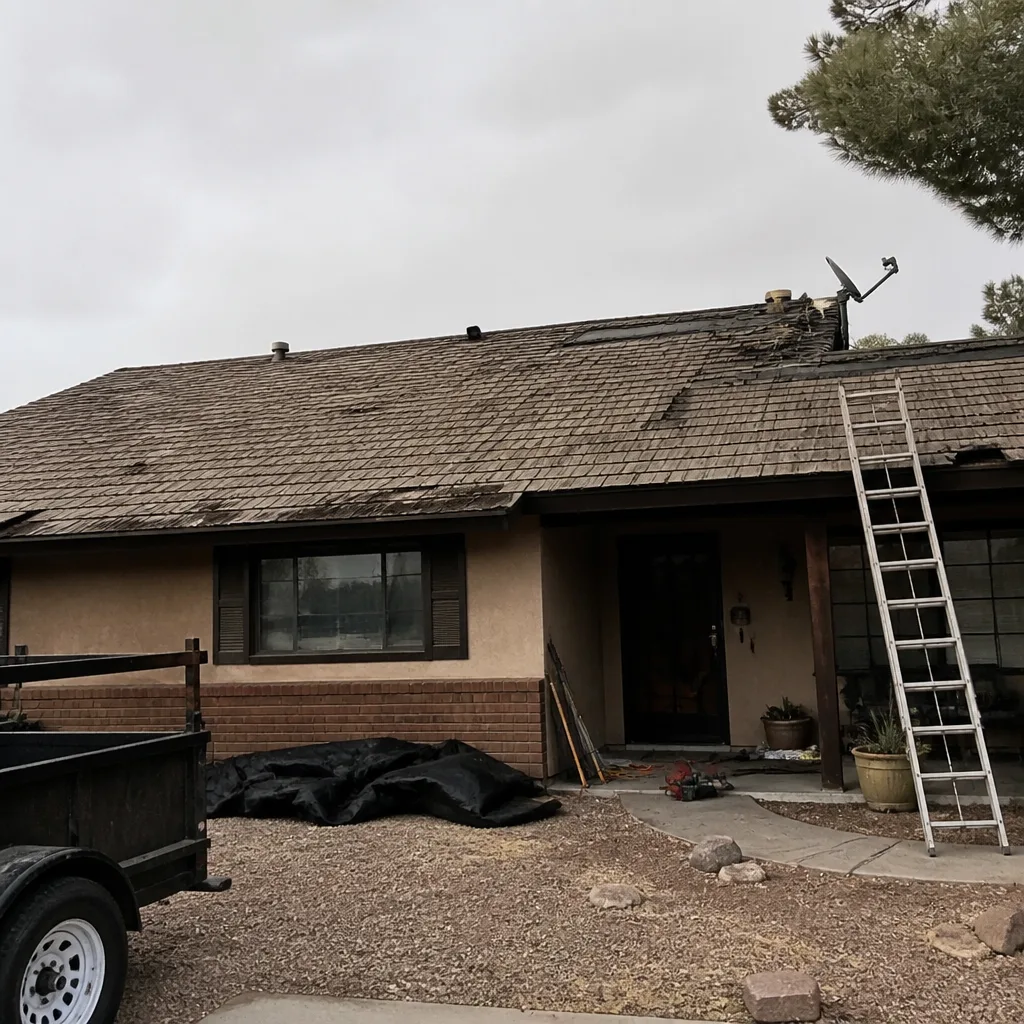 Before
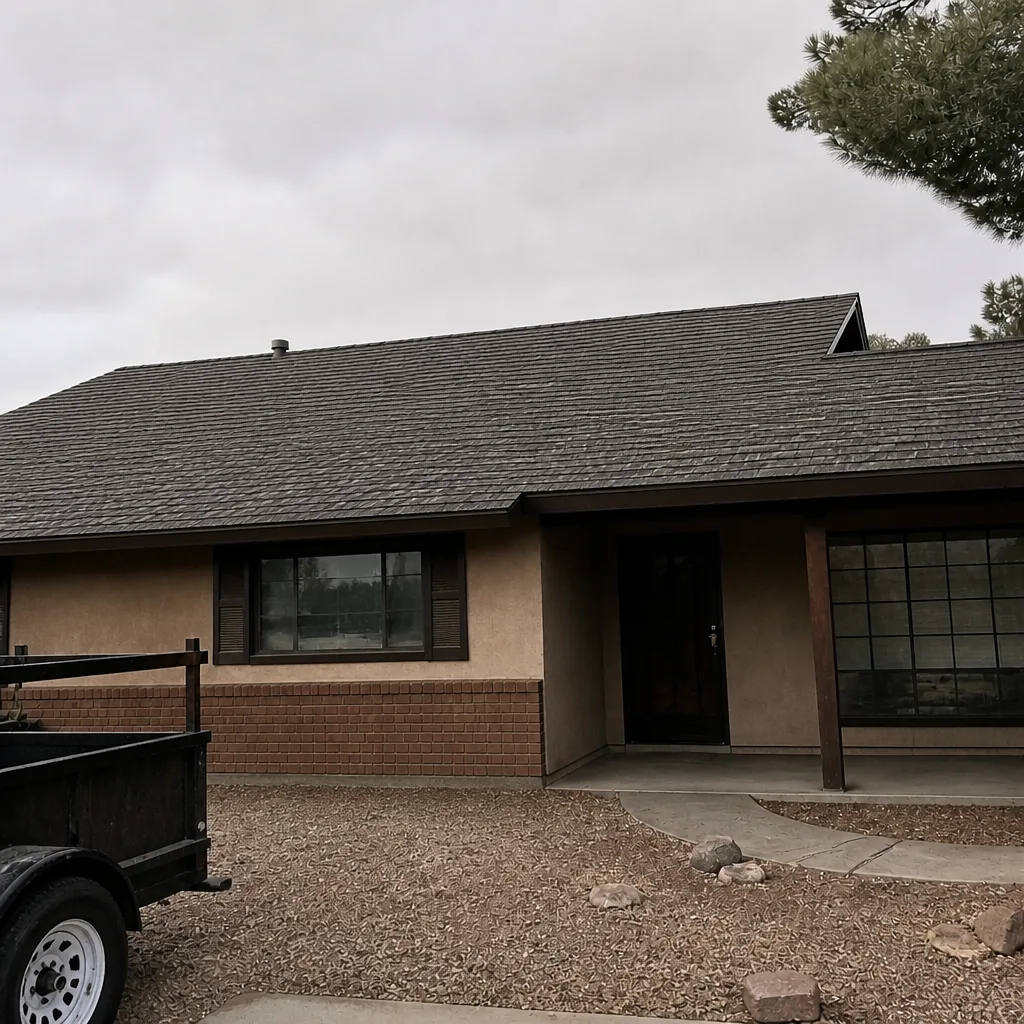 After
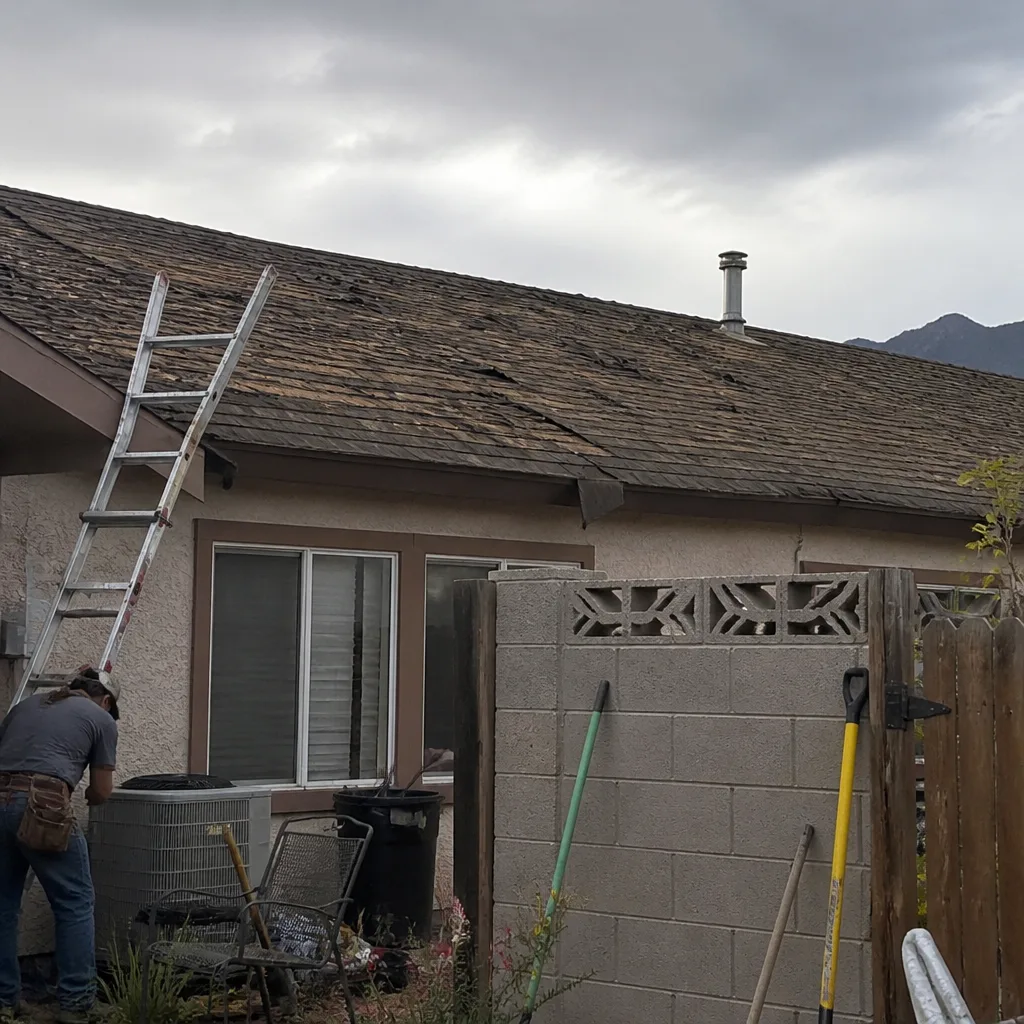 Before
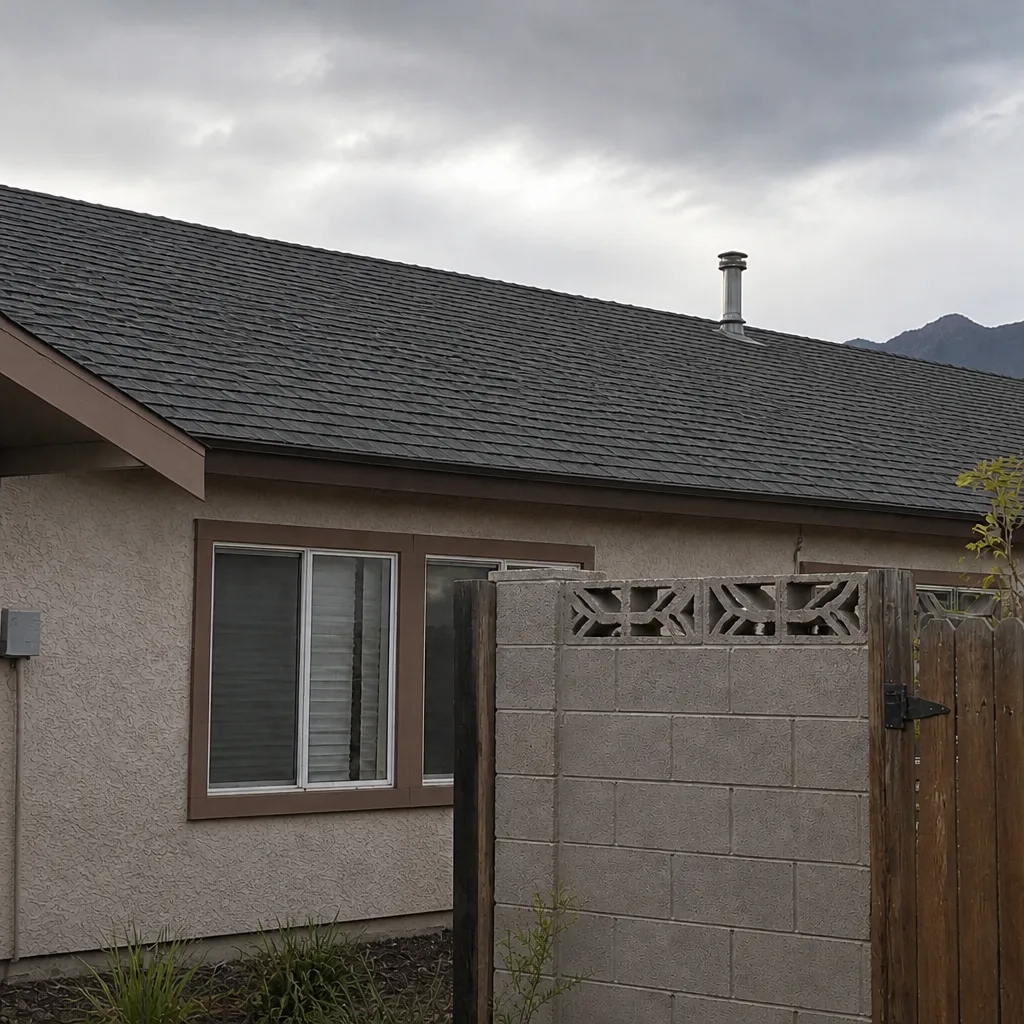 After
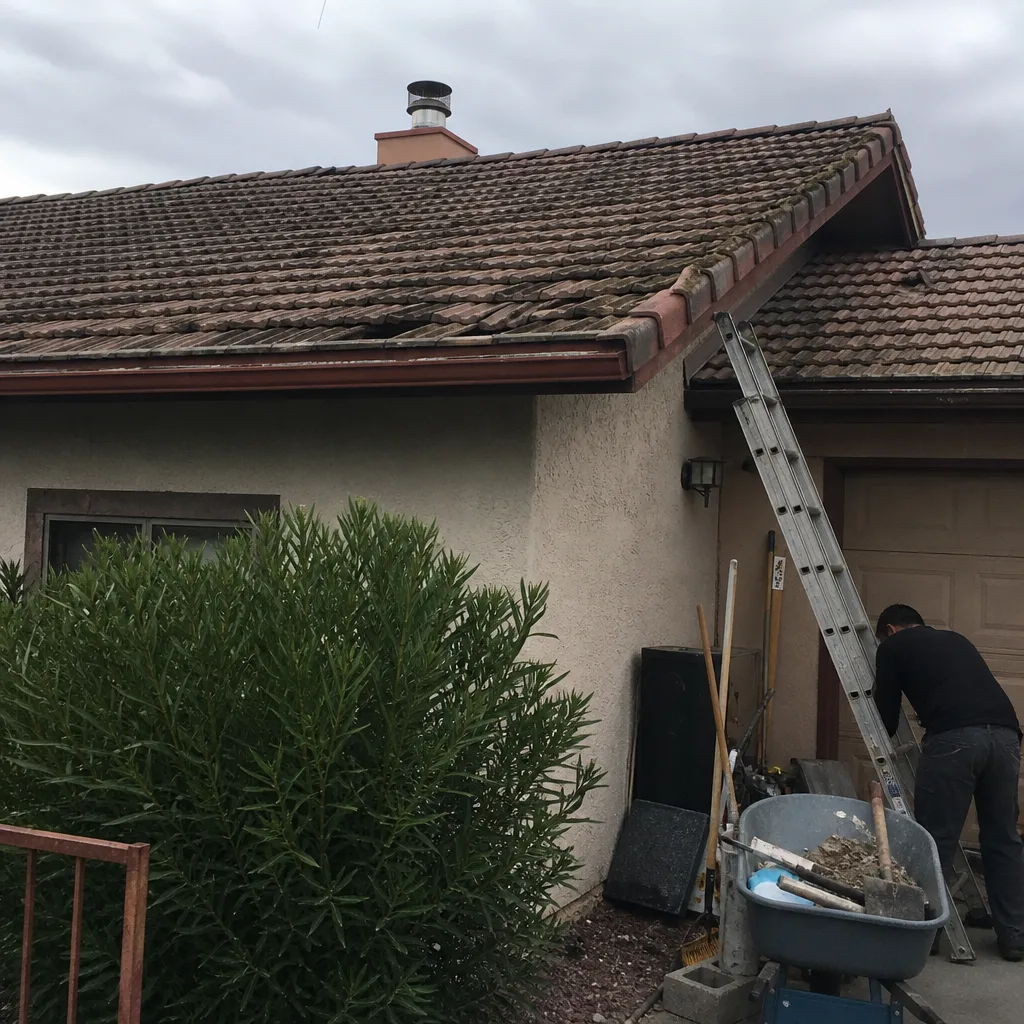 Before
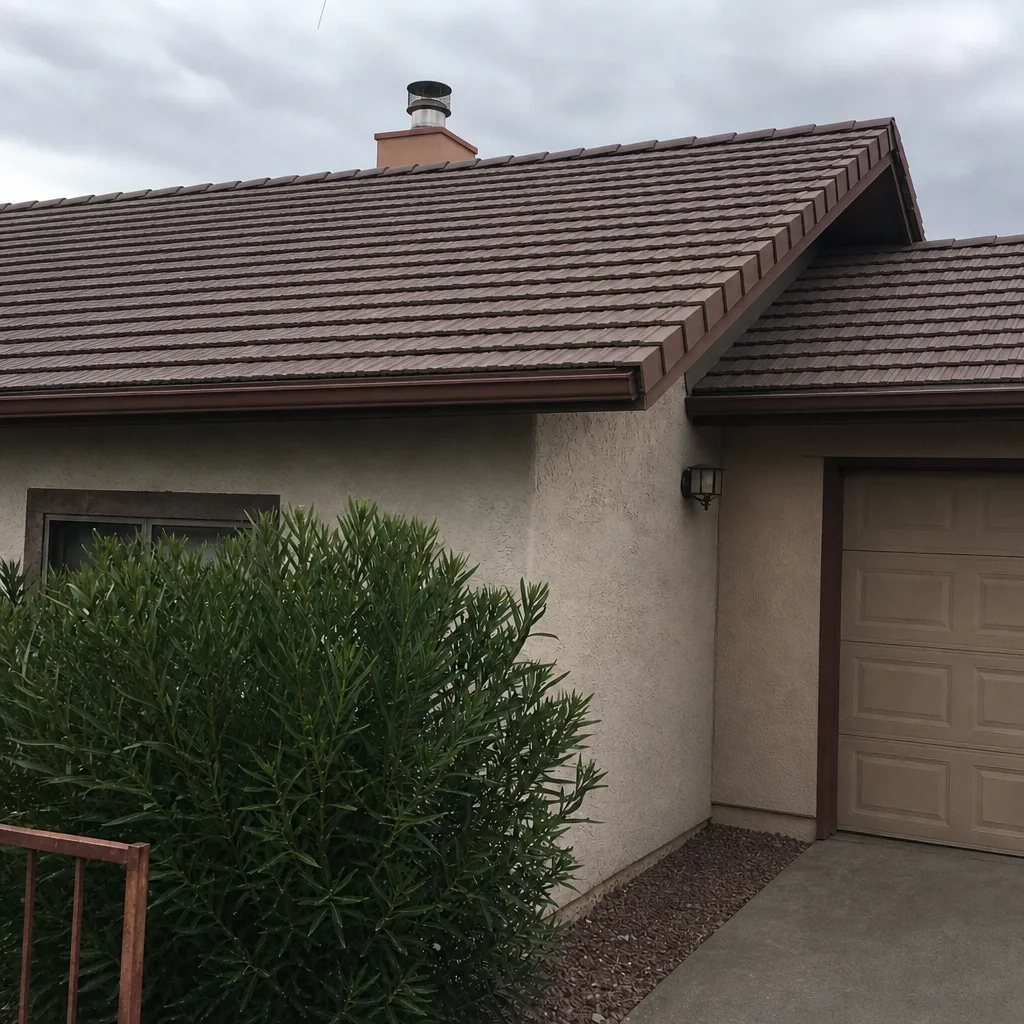 After
When to Call a Professional
Some of this guide you can do yourself safely: read the stain, mark the triangle, run a hose test from the ground, clear debris from valleys. But some issues need a trained pro on the roof with proper fall protection. Call us if any of the following is true: you can’t safely see the leak zone from the ground; the stain has grown in the last 30 days; you see daylight through the decking from the attic; flashing or a valley is involved; you’re on a low-slope roof with any ponding; or you’ve been quoted a full replacement without photographs of the deck. Shepherd & Sons Roofing Boulder City offers free estimates in Boulder City – call (844) 761-8186. A live person answers 24/7, and there’s no trip charge inside our own county.
Frequently Asked Questions
Mark the oldest edge of the ceiling stain with tape, then trace uphill toward the nearest ridge, spreading your search about 15 to 20 degrees on either side. Check penetrations, pipe boots, flashing, and valleys before you check the shingles above the stain. Water runs along rafters and decking, so the entry point is usually up and to the side, not straight up.
Yes. Have one person on the ground spray a low, gentle sheet of water at one suspect zone at a time while a second person watches the stain inside. Wait two to five minutes between zones – water takes time to travel. If the stain grows during a particular zone, you’ve isolated the leak. Call us at (844) 761-8186 if the hose test points to flashing or a valley, and we’ll confirm the source with a free estimate.
Because the shingles usually weren’t the source of the leak. A pipe boot, piece of flashing, valley detail, or fastener back-out almost always is. Replacing field shingles without fixing the underlying penetration hides the entry point for a season and lets water keep working through the deck. Call us with the stain location and we’ll re-trace it from the top of the triangle to the bottom, and give you a written line-item quote for the real repair.
Most roof leak repairs in Boulder City run between $150 and $900, depending on what’s actually failing. A pipe boot is at the low end. A valley or low-slope seam repair is at the high end. You’ll know the number before anyone touches your roof, and our $40 off any repair over $200 applies automatically. Call (844) 761-8186 for a free estimate.
No. Flat and low-slope roofs fail at seams and ponding zones, not at field shingles. Water on a flat roof runs under the membrane and drips at the nearest low spot, sometimes 20 feet from the actual crack. If your stain sits under a low-slope section of a Boulder City ranch home, tell the roofer that on the phone – it changes the diagnosis path.
The roofer should have been on your roof, in your attic, or both, and should show you photographs of the deck or the source before quoting. A written line-item estimate, a license number on the bid, and a written warranty should all be present. If the bid is a lump sum with no photos, no line items, and no license number, walk away. Our second-opinion offer on any existing written estimate is free and has no obligation. Call (844) 761-8186 to set one up.
The Bottom Line
The wet spot on your ceiling is the end of the story, not the beginning. Trace it uphill. Test it safely from the ground. Fix the flashing, the pipe boot, or the valley – not the shingles above the stain – unless the shingles themselves have actually failed. Call someone who shows you the deck photos before they talk money, and who can put a license number and a written warranty in front of you. If you’re on a Boulder City ranch home, get eyes on the ridge caps and boots before monsoon season. That’s what saves the ceiling. If your house needs a closer look, or you want a second opinion on a bid, call (844) 761-8186 for a free estimate, and we’ll be there.
Written by the team at Shepherd & Sons Roofing Boulder City.