
Last updated November 17, 2026
 Architectural shingles
 Metal roofing
 Tile roofing
 GAF
 Owens Corning
 Flat & low-slope
Free roof inspection with deck photos before we talk money - GAF and Owens Corning certified installation
Roof Replacement & Installation Warning Signs Every Homeowner Should Know
Bill has re-roofed 14 houses in Boulder City that were “just done” by another contractor. In 11 of those 14, the homeowner had no permit number, no manufacturer warranty paperwork, and no photos of the decking. That’s not an oversight. That’s a pattern. When a crew packs up and the only thing you’re left holding is a handshake and an invoice, there’s nothing to check the work against later. What follows is what we actually look for when someone calls us worried about a fresh roof – the signs that hide in the attic, at the ridge line, and in the paperwork you were never handed. This guide walks you through all three.
Quick Answer
The most reliable signs of a bad roof installation are things you can verify without climbing a ladder: missing permit records and manufacturer warranty paperwork, no photos of the decking before the shingles went down, exposed fasteners or staples you can spot from the ground, rusted or unsealed flashing around swamp cooler bases and skylights, and attic clues like daylight at the ridge or ventilation that was never sized to the roof. Crooked shingle lines look wrong but are mostly cosmetic. Exposed fasteners and missing paperwork are the structural warning signs – and in Boulder City, the desert sun and monsoon season will find both within a year or two.
Styles & brands we work with
- Architectural shingles
- Metal roofing
- Tile roofing
- GAF
- Owens Corning
- Flat & low-slope
Table of Contents
- The Three Documents You Should Have Before the Truck Leaves
- Attic Inspection: What a Bad Install Looks Like From Underneath
- Crooked Shingle Lines vs. Exposed Fasteners: Telling Cosmetic From Structural
- Boulder City Flash Points: Swamp Cooler Bases and Skylights
- Ventilation That Was Never Sized for the Roof
- Warning Signs in the Contractor, Not Just the Roof
- What to Do If You Already Suspect a Botched Install
The Three Documents You Should Have Before the Truck Leaves
This is where nearly every bad install gets caught – not on the roof, but in a folder. Before the last nail gun goes back in the truck, you should be holding three things. If the contractor can’t produce them, that tells you more than any inspection will.
- The permit number and the inspection record. A re-roof in Boulder City requires a permit, and the inspection is the city’s independent set of eyes on the work. If nobody pulled one, nobody verified the nailing pattern, the underlayment, or the flashing. Ask for the permit number in writing. A legitimate roofer will have it before the first shingle comes off.
- The manufacturer warranty registration. Shingles from CertainTeed, Owens Corning, or IKO carry a materials warranty, and many of the stronger coverage tiers only apply when the roof was installed to the manufacturer’s spec by a contractor who registers it. If your paperwork stops at the shingle wrapper, the warranty may not follow you.
- Photos of the decking. The deck is what the whole roof sits on, and it’s the one thing you can never see again once the shingles are on. A roofer who won’t photograph it is asking you to take the deck on faith.
We show deck photos before we ever talk money. It’s not a sales move – it’s the difference between a documented job and a guessing game. If your contractor “has them somewhere,” get them in your inbox before final payment.
Attic Inspection: What a Bad Install Looks Like From Underneath
Most of the worst install problems never show up from the street. They show up from inside the attic, with a flashlight, on a cool morning. Here’s what to look for.
- Daylight at the ridge or the eaves. A thin line of light along the ridge board or where the roof meets the exterior wall usually means ridge vent material wasn’t seated right or fascia and drip edge work left gaps. A little light at a vent is normal. A bright seam is not.
- Water staining on rafters or sheathing right after a storm. A new roof should be dry underneath. If you’re seeing dark rings or soft sheathing within months of the install, the underlayment or flashing failed – and it’s worth calling before the next rain.
- Misaligned or gapped decking. Boards with wide gaps, sagging between rafters, or obvious soft spots mean the deck wasn’t checked or replaced when it should have been. Shingles over a bad deck will telegraph every gap within a season.
- Ice-and-water shield in the wrong place. In Nevada we don’t fight ice dams, but a proper install still runs the waterproof membrane at the eaves, in valleys, and around penetrations. If you can see bare felt in those spots instead of the shield, the installer skipped a step.
- Ventilation you can feel is wrong. On a hot afternoon, a poorly vented attic traps heat and shortens shingle life. Feel the soffit and ridge vents. If there’s no airflow, something was undersized.
Take photos of everything you find, note the date, and keep them with your paperwork. In Boulder City, where summer attic temperatures regularly climb past 140 degrees, ventilation problems show up fast – and they’re easier to prove in the first year than the third.
Crooked Shingle Lines vs. Exposed Fasteners: Telling Cosmetic From Structural
Homeowners often panic about the wrong things. A shingle course that wanders an inch or two off level looks sloppy, but it won’t leak. Exposed nails and staples are a different animal – those are the structural signs, and they’re the ones worth a call.
Here’s the distinction, plainly:
- Cosmetic: wavy shingle lines, color variation between bundles, slightly uneven butt joints, individual shingles that look a little proud of the course. Ugly, but not leaking.
- Structural: nail heads visible on the face of shingles (not just at the ridge and hips where they’re supposed to be sealed), staples instead of nails on a dimensional shingle, nails driven too high or too low so the shingle can’t seal, and ridge cap shingles pop-nailed so the heads lift in the heat.
From the ground, look along each roofline for shiny specks – those are exposed fasteners catching the sun. A few at the ridge are normal if they’re properly sealed with roof cement. A scatter across a field of shingles is not. The nailing pattern earns the wind rating, not the shingle wrapper. A certain Owens Corning or Atlas shingle rated for high wind only performs to that number if it was nailed to spec, and every exposed head is a spot where the wind will start lifting first.
On a pitched roof, don’t climb up to check. Ground-level inspection with binoculars is enough to justify a professional look. That’s what the free second opinion is for.
Boulder City Flash Points: Swamp Cooler Bases and Skylights
On desert roofs, water gets in at the penetrations, not the field. Two spots fail more than any other in Boulder City: swamp cooler bases and skylights. Both are flashings, and both are where a rushed install goes wrong.
Swamp cooler bases. An evaporative cooler sits on a curb with a flashing transition that has to be sealed, fastened, and then re-sealed at the corners. In our experience, we regularly see these curbs flashed with caulk and hope – no proper membrane, no metal counter-flashing, no attention to the corners where the curb meets the roof. Caulk fails in a summer under the desert sun. By the first monsoon season, the water is running down the underside of the deck. If your new roof left your cooler curb looking patched rather than rebuilt, get it looked at before the rains.
Skylights. A skylight flash kit comes with step flashing, head flashing, and a sealant strip ordered for the specific unit. Installers who skip the kit and “make it work” with roofing cement leave you with a leak that won’t show until the first hard rain. Check the perimeter of each skylight for sealant smeared over the frame, gaps at the corners, or missing step flashing tucked under the course above.
For more on how these repairs and installs should be handled, see Roof Repair in Boulder City.
Ventilation That Was Never Sized for the Roof
A roof that’s installed well but ventilated badly will still fail early. In a Boulder City summer, an attic without proper intake and exhaust bakes the shingles from underneath and quietly eats a decade off the roof’s life. The install matters, but so does the math behind it.
Here’s what to check:
- Intake and exhaust match. A balanced attic needs roughly equal soffit intake and ridge or gable exhaust. If the installer added ridge vents without opening the soffits, the roof has no intake path and the ridge vents do almost nothing.
- Vents were cut, not just set. We’ve seen ridge vent strips set on top of solid sheathing with no slot cut underneath – all the look, none of the function.
- Bathroom and kitchen fans vent to the outside. In the attic, look for exhaust ducts dumping warm moist air into the space instead of through the roof or a wall. That moisture is a slow killer of the deck.
- Ridge vents sized to the roof. A three-vent setup on a large roof may be far short of what the roof needs. The number should have been calculated before the install, not after.
If you’re not sure whether your new roof was vented correctly, the attic will tell you. Hot air pooling at the ridge, condensation on the sheathing in cooler months, or a ridge vent that’s clearly decorative are all signs worth investigating.
Warning Signs in the Contractor, Not Just the Roof
Most bad installs, honestly, start before a single shingle is lifted. The signs are in how the contractor operates. Here’s the pattern we see most often.
- The price moved between the phone and the door. A quote given sight-unseen over the phone that climbs once the roofer is standing in your driveway is the oldest trick there is. A real quote comes after the roofer measures the roof, counts the squares, and walks the deck.
- No permit was pulled. If a company shrugs at Boulder City’s permit process, that’s not speed – that’s a shortcut that leaves you holding the inspection.
- The address or license number is missing from the truck, the quote, or the website. A local roofer is findable. Search the license, look at the address, check the name on the truck against the name on the license.
- Nobody answers the phone after the job. Storm chasers show up after every hail event in Boulder City, do the work, and vanish. When the leak starts, the number is dead. That’s not a contractor. That’s a cost.
- No written warranty on labor. Materials warranties are one thing. Labor coverage in writing is another, and any roofer who won’t put a pledge on paper isn’t planning to come back.
We’ve had the same address since 1996, and the name on the truck is the name on the license. When storm chasers roll through after a Boulder City hail event, ask them where their shop is and how long they’ll be reachable. For a deeper look at how a proper install is planned from the start, see Roof Replacement & Installation in Boulder City.
What to Do If You Already Suspect a Botched Install
If you’re reading this and your roof was just replaced, and something feels off, you have more options than you might think. Here’s the realistic ladder, from least to most expensive.
- Document everything, immediately. Photos of exposed fasteners, attic stains, flashing problems, plus a copy of the contract, the invoices, any texts or emails with the contractor. This is the single most important step.
- Locate the permit and inspection record. Call Boulder City’s building department with your address. If a permit was pulled and inspected, you have one version of the truth. If no permit was pulled, that’s a finding.
- Get a written second opinion. A qualified local roofer can walk the job and tell you – in writing – what’s actually wrong and what it’ll take to fix it. This is often cheaper and faster than anything else on this list. Our second opinion on any written estimate is free.
- Contact the original contractor in writing. State the problem, attach the documentation, and ask for a specific remedy by a specific date. Keep the tone flat and factual. “The flashing at the swamp cooler curb is leaking and photographs from the install suggest it was never properly replaced.”
- Only escalate if the above fails. If the contractor won’t make it right and there’s real damage, that’s when licensing boards and, in the worst case, legal advice come into play. Most problems get resolved at step three.
If you’re ready to start the process, see Metal Roofing in Boulder City for one option if you end up needing a do-over, or read our guide to Shepherd & Sons Roofing Boulder City home for a broader view of what we handle. And if you’re weighing a different roof system entirely, metal is worth a hard look in our climate – the same desert heat that punishes a bad install punishes a bad material choice.
Common Mistakes to Avoid
- Paying in full before you have all three documents. The permit number, the manufacturer warranty registration, and the deck photos should be in hand before the last check clears. Once payment is done, leverage is gone.
- Assuming crooked lines mean a bad install. Chase exposed fasteners and missing flashing first. Wavy courses are cosmetic; silver nail heads across the field are the ones that will leak.
- Skipping the attic check. In Boulder City’s heat, attic clues show up within weeks – daylight seams, staining, sagging decking. If you don’t look, you won’t know until the ceiling tells you.
- Letting a storm chaser skip the permit because “it’ll speed things up.” In Boulder City a permit and inspection are your independent verification. A skipped inspection is a gift you don’t want.
- Ignoring the swamp cooler curb. It’s the number-one penetration leak in this climate and the easiest spot to spot-check after a re-roof. If it looks like caulk and hope, get it looked at.
- Hiring the lowest bid without checking the count. A roof is measured in squares. Ask every bidder how many they counted. If the counts don’t match between bids, the low one is probably short somewhere.
- Never following up on ventilation math. A ridge vent that wasn’t sized to the roof, or installed over solid sheathing, quietly shortens the shingles’ life. Ask for the calculation.
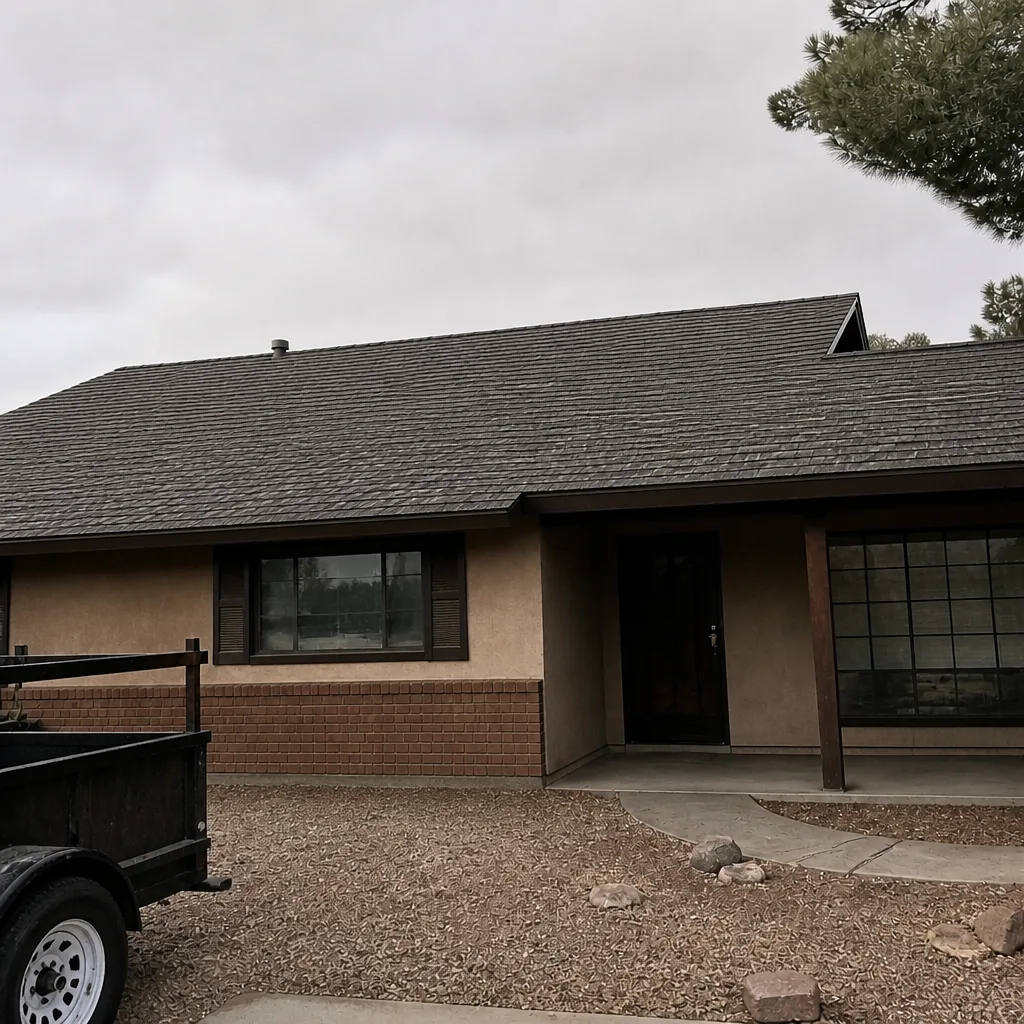
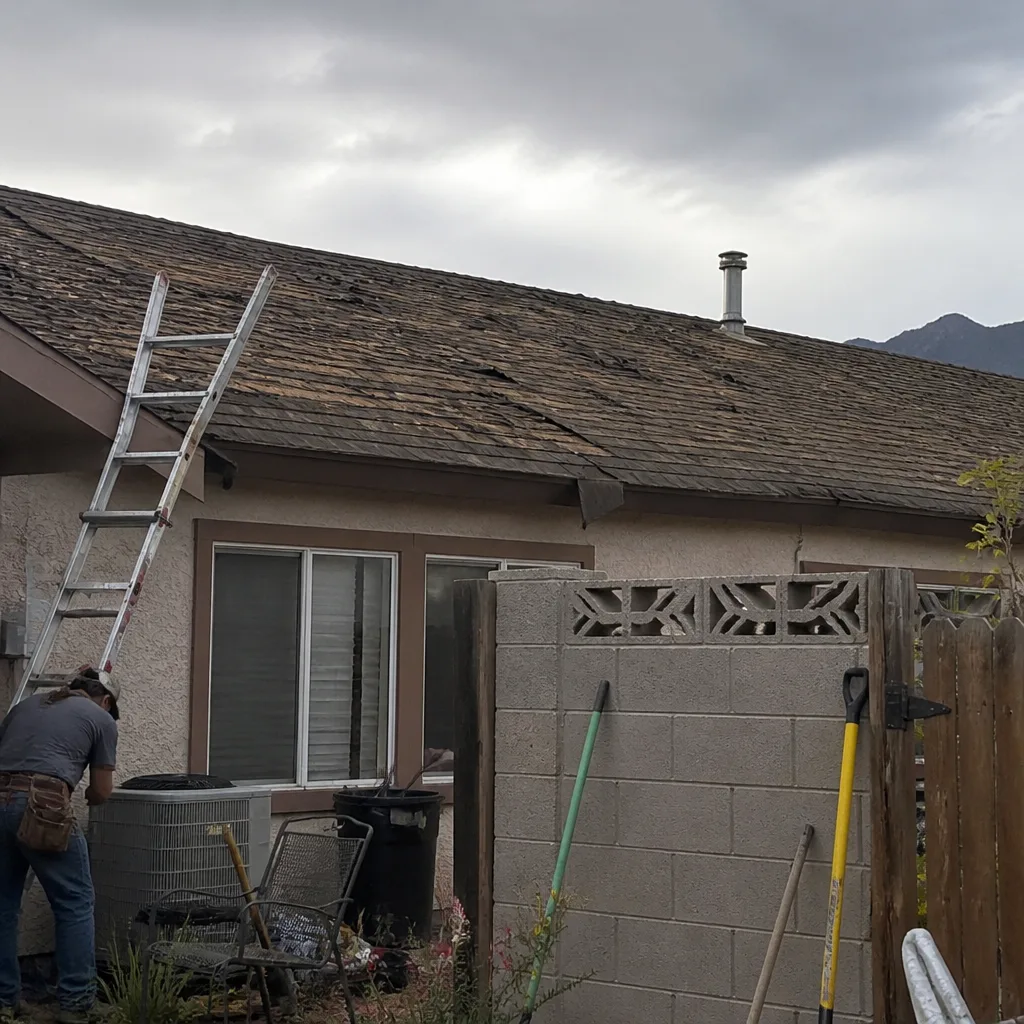
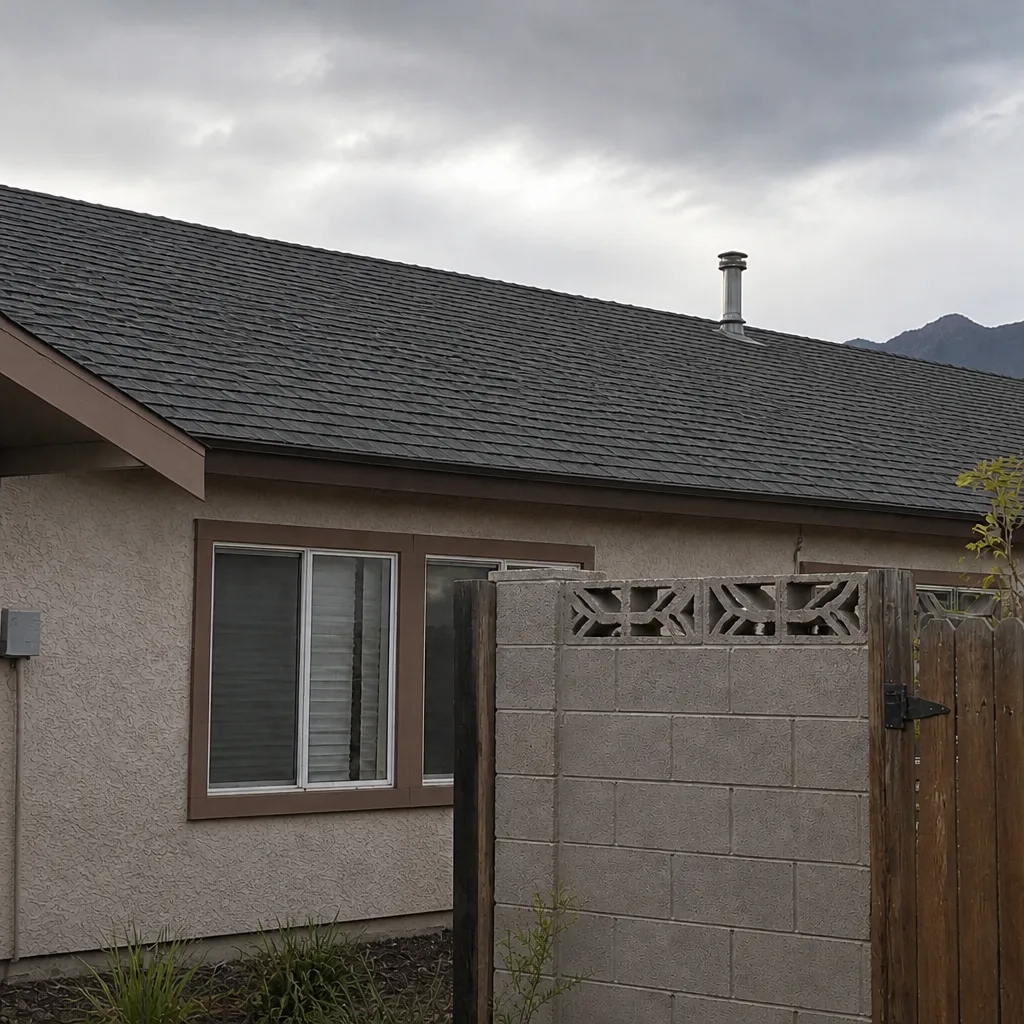
See the difference
 Before
 After
 Before
 After
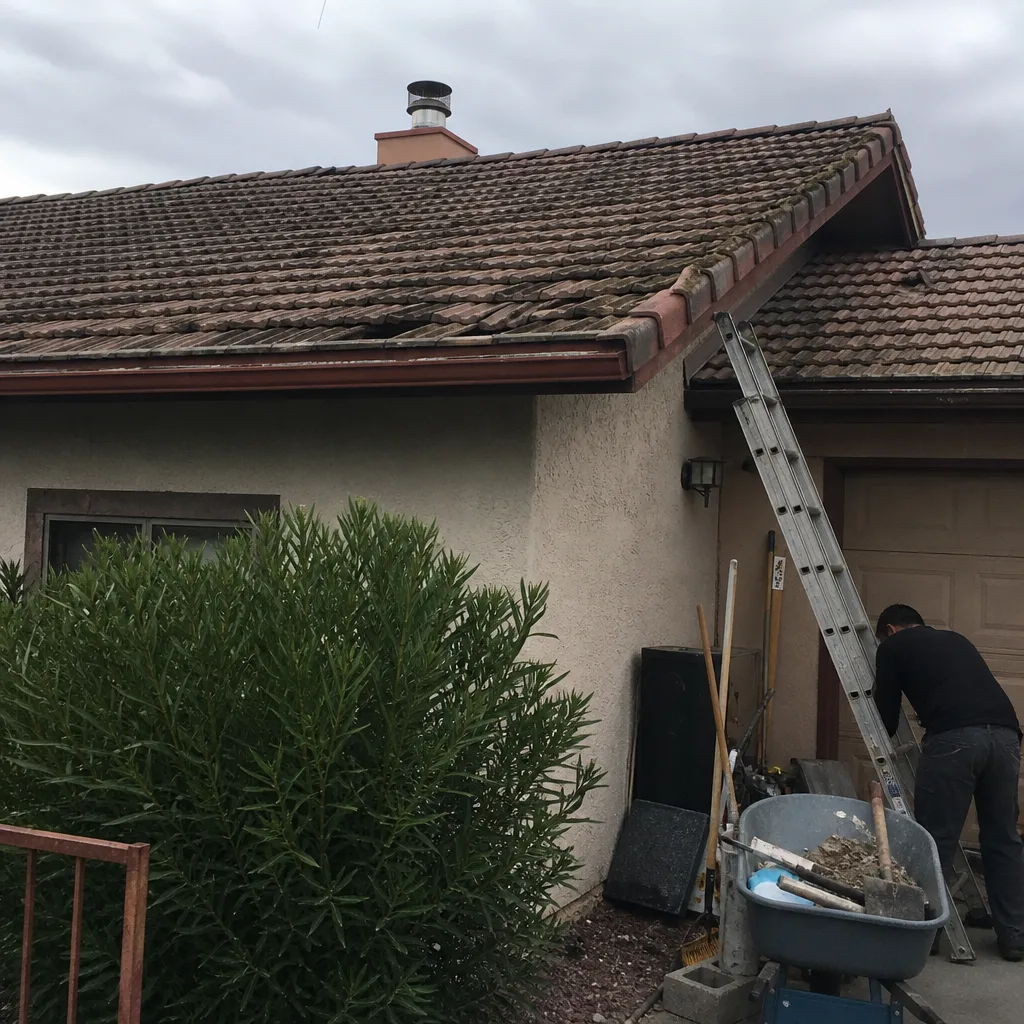 Before
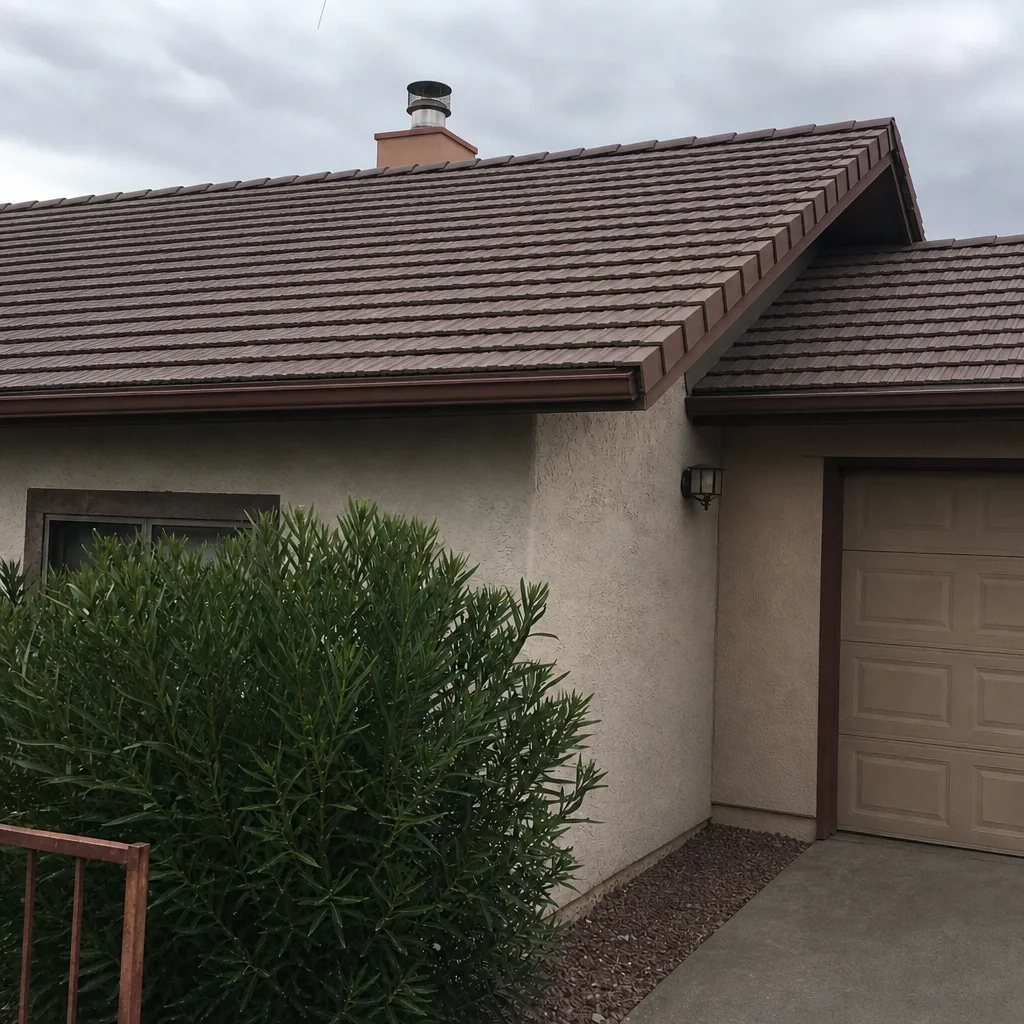 After
When to Call a Professional
Call a professional if you can see exposed nails or staples on the shingles, if any flashing looks patched rather than properly rebuilt, if there’s daylight at the ridge or staining on the sheathing inside the attic, or if your contractor can’t produce the permit, the warranty paperwork, or photos of the decking. Also call if the original crew has gone quiet, the price changed after the bid, or a storm chaser skipped the inspection. Any one of those is enough to justify a walkthrough. Shepherd & Sons Roofing Boulder City offers free estimates and a free second opinion on any written estimate in Boulder City – call (844) 761-8186 and a live person will pick up, day or night. No trip charge inside our own county. Bill will come out, take a look, and tell you honestly whether your roof is fine or whether you need to start the process above.
Frequently Asked Questions
The most reliable signs are missing paperwork (no permit number, no warranty registration, no deck photos), exposed fasteners visible from the ground, poor flashing at penetrations like swamp cooler bases and skylights, and attic clues such as daylight at the ridge or staining on the sheathing. Cosmetic signs like crooked shingle lines look bad but rarely leak. Call (844) 761-8186 for a free second opinion on any install you’re unsure about.
Look along each roofline in good light and watch for shiny specks – those are nail heads catching the sun. A few sealed heads at the ridge and hips are normal. A scatter across the field means nails were driven too high or too low for the shingle to seal, which is a wind-lift risk. Have a professional inspect from the roof; don’t climb up yourself. Call (844) 761-8186 for a free estimate.
Yes, a re-roof in Boulder City requires a permit and an inspection, and the inspection record is one of the most useful documents you can hold. If no permit was pulled on your job, that’s a warning sign worth acting on. Call (844) 761-8186 and we’ll walk you through what to ask the building department.
It depends on what actually failed. Exposed fasteners, flashing at penetrations, and ventilation problems can often be corrected without tearing off the whole roof. A failed underlayment or compromised deck usually means partial reconstruction. A written second opinion is the cheapest way to find out which category you’re in. Call (844) 761-8186 – the second opinion is free.
You should have the permit number and inspection record, the manufacturer warranty registration for the shingles (CertainTeed, Owens Corning, IKO, and others all have registration steps), photos of the decking before the shingles went down, and a written labor warranty. If any are missing, ask for them in writing. Call (844) 761-8186 for a second opinion on what you were actually given.
Because they’re the two penetrations every desert roof has that get rushed. Swamp cooler curbs need proper membrane and counter-flashing, not just caulk, and skylights need the specific step-flashing kit ordered for the unit. Caulk fails fast under our sun, and the first monsoon season exposes it. If yours look patched rather than rebuilt, call (844) 761-8186 for a free estimate.
The Bottom Line
A bad roof install rarely announces itself. It hides in missing paperwork, exposed fasteners, poorly flashed penetrations, and an attic that tells on the contractor before the ceiling does. The good news is that all of it is checkable – by you, with a flashlight and a folder, in about an hour. Get the permit number, the warranty registration, and the deck photos. Look for shiny specks along the rooflines, and walk the attic for daylight and staining. And if the contractor can’t produce the documents, that’s your answer. A roof is measured in squares; accountability is measured in what’s on paper. For a look at the full range of what we handle in Boulder City, start with our Roof Repair in Boulder City page or the Roof Replacement & Installation in Boulder City overview.
If you’ve read this guide and something on your roof is nagging at you, pick up the phone. Shepherd & Sons Roofing Boulder City has been at the same address since 1996, Bill answers his own phone, and every job carries our 90-Day Done Right Promise in writing. Call (844) 761-8186 for a free estimate or a free second opinion on any written bid – a live person picks up, day or night, and there’s no trip charge inside our own county.
Written by the team at Shepherd & Sons Roofing Boulder City.